Showing posts sorted by relevance for query "Summer Flycatchers". Sort by date Show all posts

Sunday, June 28, 2009

Summer Flycatchers Part 2

On Saturday morning I birded part of Lake Creek Trail with a friend, and despite the heat we found 34 species of birds. 2 of them were Eastern Phoebe and Great Crested Flycatcher, the 2 species I wanted to include in this second post about neighborhood flycatchers. (Here's a link to the first post.) Eastern Phoebe is a rather drab bird with a dark face, head, back, wings, and tail. Its throat, breast, and belly are lighter, sometimes with a slight yellowish tinge. When perched it often pumps its tail up and down, which is a distinctive behavior that can help you identify this species. I got this picture of an Eastern Phoebe just downstream of the T&C playing fields back in 2007.


Even though Eastern Phoebes are migratory, they can be found in the neighborhood all year long. I think they might be similar to American Robins in this way. The individual birds we have here in the summer might not be the same ones that are here in the winter. In the summer I usually see Eastern Phoebes only along the creek. They prefer edges of wooded areas next to water, and and I usually see them near the patches of woods we have by the creek rather than out in the open fields that Scissor-tailed Flycatchers and Western Kingbirds prefer. Eastern Phoebes have a distinctive song, and their name comes from part of the song which (sort of) sounds like the word "phoebe". Learning its song is a good way to find these birds, but beware, their song is often copied by our Northern Mockingbirds!
The Great Crested Flycatcher resembles the Western Kingbird in several ways. It has a grayish face and breast, and yellow lower breast and belly. But the gray is darker, and the top of its head and back have much more brown in them than the kingbird. The tail is mostly reddish brown (a color known as "rufous" in the birding world) and this same color can be seen in the wings' primary flight feathers. Despite its name, the Great Crested Flycatcher has only a small crest on its head which is often not raised. (I think the "Great" refers to the bird's overall slightly large size relative to some other flycatchers, and not to its crest.) This is the best picture I have gotten of a Great Crested Flycatcher in the neighborhood so far, and it's only mediocre. I took it in September, 2007.


One reason I don't have a good picture of this bird is because it is the most secretive of the 4 flycatchers I'm writing about. It often remains still, perched in denser parts of the tree canopy,. So seeing one can be difficult and it's a real treat when you do. Usually I hear a Great Crested Flycatcher before I see it, and often even after hearing one I can never lay eyes on it. So it's very useful to learn its harsh song and calls here. Like the Eastern Phoebe, the Great Crested Flycatcher prefers forest edges. But unlike the phoebe, it can be found away from the creek as well as near it. So it occurs among the houses in our neighborhood more often than the other flycatchers do, usually in the heavier wooded areas.

Great Crested Flycatchers breed here, and they are only here in the summer; they winter in southern Mexico and Central America. They are the only neighborhood flycatcher that nests in cavities, both old woodpecker holes and artificial structures. So they are the only neighborhood flycatcher that might use a bird house. Here are some guidelines for making one.

I hope my 2 Neighborhood Flycatcher posts encourage you to keep looking for birds in the neighborhood even through our hot summer months. If you can get outside early enough in the morning it can still be quite pleasant, and that's when the birds are most active and easiest to enjoy.

One last note. Moria Darnell is the first person to complete the NASWC Top 20 Bird List and Challenge! On 6/28 she found 2 juvenile Eastern Screech-Owls on Broadmeade Avenue, the last species she needed. Congratulations Moria!

Sunday, June 21, 2009

Summer Flycatchers Part 1

June is the slowest month for birding in central Texas, but if you get out early enough there are still many year-round-resident and summer-resident birds to enjoy. In the neighborhood right now we have 4 species of breeding flycatchers. Flycatchers are a family of birds that specialize in catching and eating flying insects. As a group they usually have an upright posture and like to perch on exposed branches or fence posts, making forays out to catch a bug and then returning to their perch to eat it. The 2 easiest species to find are Western Kingbirds and Scissor-tailed Flycatchers.

The Western Kingbird is a mid-sized bird with a gray head, grayish throat and breast, a yellow belly, dark wings, and a black squared off tail with white outer tail feathers. I got this picture of one in 2007 near where the footbridge on Lake Creek Trail is now.


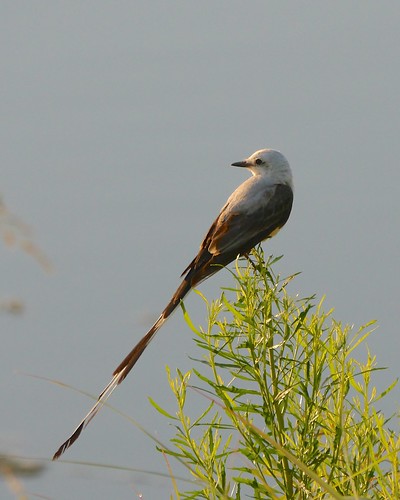
The Scissor-tailed Flycatcher is almost the same size but has an extremely long black and white tail that scissors apart when it flies. Its head and breast are white and it has a light pink belly. Under its dark wings are bright pink patches that you usually only catch glimpses of as it flies -- it's a dramatic and beautiful bird to see. Its bright colors and long tail are exotic and tropical, and it's a common neighborhood summer resident! I got this picture of one on the T&C playing fields back in April of 2008:


Both of these species are only here in the summer. They winter in southern Mexico and along the Pacific coast and slope of Central America. Scissor-tailed Flycatchers breed in Texas and a few surrounding states, and Western Kingbirds breed over most of the western and central United States. Both prefer open habitat, with scattered trees or fences to perch and nest on. In the neighborhood I see these birds most often on Lake Creek Trail where it goes through the T&C playing fields, and at the new Parmer Village development. I also often see both species in (of all places) parking lots that have a few trees. It's fortunate for them that they can take advantage of such a common urban setting. Both species make very similar sounds, and often you can hear their single "quip" call notes before finding one on a nearby tree or fence.

These are fun birds to watch. Besides being so pretty, you can often watch them catch insects out of the air and then eat them at their perch. It's also not too hard to find their nests, often right in a large obvious tree in the middle of a field or parking lot. And they are very territorial and aggressive. It is not uncommon to see them chasing off other birds much larger than they are, including hawks, crows, and even Turkey Vultures! So go try to find these 2 species and let me know when you see them!

Sunday, August 3, 2008

NASWC Bird Walk

There were 6 of us who braved the summer heat this morning for the August NASWC Bird Walk. We were supposed to have cloudy conditions for half the morning but it was completely clear. Even so, there was a nice breeze and things didn't get too hot if we stayed in the shade. The birding was interesting and fun. We found 42 species and here are the highlights:
  • Before everyone arrived, we briefly heard and then saw a male Orchard Oriole which perched obviously and then flew right over us. This is my first summer record of one in the neighborhood. But after looking at my records I'm wondering, could this bird have been an early south-bound migrant?
  • The juvenile Turkey Vulture pictured above was near the Lake Creek Trail footbridge and let us get pretty close. In the picture you can see daylight through its nostrils. Turkey Vultures are one of the few birds with a well-developed sense of smell.
  • We saw a cormorant flying in the distance, and this time of year by far the most likely species is Neotropic Cormorant, a first for my NASWC bird list!
  • From the Lake Creek Trail footbridge we saw at least 4 Western Kingbirds. I got this picture of one of them. Surprisingly absent were Scissor-tailed Flycatchers. I have seen very few on the T&C playing fields this summer.
  • Also from the footbridge and nearby we saw at least 5 Painted Buntings in and around the creek bed. This was the easiest time I've ever had viewing Painted Buntings in the neighborhood. And there were more here than I've ever seen before during the summer. I can't resist posting this poor photo I took of 2 of them:
  • Near the last dam on Lake Creek we found an empidonax flycatcher in the woods which we finally figured out was a Least Flycatcher, the first south-bound migrating songbird I've seen this year.
  • On our way back we found a single Lark Sparrow foraging at the edge of the soccer fields. This is one of the few native sparrows that can be found in the Austin area during the summer. (Most are only here in the winter.) It is also my first summer record of one in the NASWC area.
I used to bird very little in the summer, thinking it was the least interesting time of year and there were few birds to be found. But my summer birding in the neighborhood has shown me that that's just not the case!

Sunday, July 5, 2009

NASWC Bird Walk

Despite the warm weather, 5 of us participated in the July NASWC Bird Walk this morning. We were lucky and enjoyed a nice breeze and partly cloudy skies for most of the walk. After a slow start we were able to find 33 species of birds. Here are some highlights.
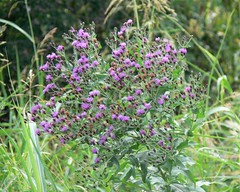
  • Bill Dodd identified this vibrant purple flowered plant as Western Ironweed. It's so great that Bill and a few other regular folks on my bird walks know how to identify lots of plants and butterflies!


  • A small group of Carolina Chickadees and Black-crested Titmice crossed the trail right over us giving us great looks at these small but common year-round resident species.
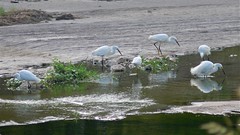
  • We encountered this group of 8 Snowy Egrets and watched them actively hunting in the creek. Snowy Egrets don't stay as still as other kinds of herons and egrets when hunting. They run and jump around, chasing small fish and aquatic insects.


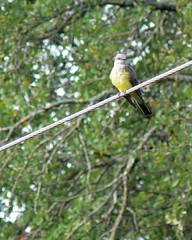
  • By the footbridge we saw 2 of the flycatchers I recently wrote about in my Summer Flycatchers blog posts: Western Kingbirds and Great Crested Flycatchers. Here is one of the Western Kingbirds we saw.


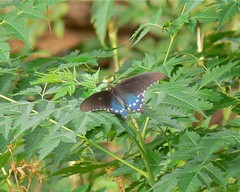
  • Right by the trail we found this resting Pipevine Swallowtail butterfly. In my experience, it's fortunate to find one staying still enough to take its picture.


Sunday, September 8, 2013

Birds, Dragonflies, and More

Yesterday morning I birded the entire length of Lake Creek Trail, starting at the Braes Valley parking lot. I was hoping to observe some of the increased fall migration activity recently reported by Chuck Sexton and Barry Noret here, but since there hadn't been a recent weather event, bird activity was relatively quiet. Still, here and there, I managed to find a few migrants. The only one I manage to photograph was one of three or four female or first-year Baltimore Orioles in the eastern end of the Town and Country playing fields:

Baltimore Oriole


Other migrating birds included a few Yellow Warblers and Wilson's Warblers, a single Yellow-breasted Chat, a few empidonax flycatchers, and a heard-only Summer Tanager. I recorded the tanager with SoundCloud, and online tool increasingly being used to record nature sounds. Here's its diagnostic call:


I briefly saw a Tricolored Heron along the creek. These are coastal birds, but immature Tricolored Herons commonly wander inland during the summer. We've had them on Lake Creek in past summers, but this was the first I've found this summer.

I made some interesting non-bird observations on the trail.

Sunday, August 10, 2008

A Few Southbound Migrants

I spent almost 4 hours birding the neighborhood this morning and found 42 species of birds. It was uncommonly quiet and peaceful on the streets even for a Sunday morning, and there was a light breeze. So I really enjoyed being out there once I left the house at around 7:20 AM. I was able to lose myself listening and looking for birds, without worrying about car traffic or other neighborhood noises. There are more early southbound migrating birds showing up. From the Lake Creek Trail footbridge I saw 3 Painted Buntings -- 2 females and 1 male. I got this picture of one of the females but the male never got close enough. (In the summer, any little green bird you see is likely a Painted Bunting female or young male. But in the winter, any little green bird you see could be an Orange-crowned Warbler or a Ruby-crowned Kinglet.)

Nearby I found 2 female Orchard Orioles bathing in the creek. More and more, I'm convinced that the Orchard Oriole we saw last weekend was migrating south. I could be wrong, but I don't think these birds summer in the neighborhood. I also saw and heard 2 Blue-gray Gnatcatchers, the first I've seen this season. And I counted 6 Least Flycatchers. I even got this mediocre picture of one near the last dam on the creek. These are small and very active birds. Often you can hear their soft "pwit" call much easier than you can actually see them up in the treetops. In this picture you can see the white eye-ring, a characteristic of all Empidonax flycatchers. This is a very difficult group of birds to identify, and I've only recently started learning how to recognize a few of them.


I found the Tricolored Heron again. I assume it's the same juvenile bird I saw a couple weeks ago but I really have no way of knowing. I got to watch its active feeding style again and at one point I had the Tricolored Heron, a Green Heron, and a Snowy Egret in the same binocular view. Combined with hearing a cheering crowd from the nearby soccer fields, the experience was a little bit surreal! A little later I was able to get pretty close to the Tricolored Heron, and I got this picture before it got spooked and flew downstream.

Sunday, July 29, 2007

Flycatchers and Hike & Bike Trail Progress


I spent about 2 and a half hours birding the neighborhood this morning. There were several Western Kingbirds and Scissor-tailed Flycatchers where the 2 creeks meet at the end of Meadowheath. This picture of one of the Western Kingbirds shows its characteristic flycatcher shape and black tail with white outer tail feathers. Nearby I also got a picture of 2 Scissor-tailed Flycatchers and 1 Western Kingbird on the same bush. (The kingbird is on the lower right.) Notice how similar these species are to each other. Especially since the scissor-tails are young birds whose tails are not very long yet.

I went onto the flood plain property for the first time in weeks. Our wet summer has made that place extremely muddy and overgrown. But it was worth dealing with the tall grass, mud, and mosquitos. I found a tiny Blue-gray Gnatcatcher -- the first one I've seen in the neighborhood since spring migration. There was also a Ladder-backed Woodpecker and a Yellow-billed Cuckoo. I was also pleased to see that the county has started work on the hike-and-bike trail. There is a newly bulldozed path starting from the end of Braes Valley that follows the creek almost to where it meets the tributary. I think it's about 3/4 done. They are following an existing old truck trail so not many trees had to be disturbed. You can see in this picture how it even goes underneath a bit of canopy. I can't wait to see how the development progresses!

Sunday, April 5, 2009

NASWC Bird Walk

10 of us participated in the April NASWC Bird Walk this morning. It was sunny and clear but there was a strong cold north wind blowing all morning that made finding birds a little harder than usual. Still we managed to find 30 species on the short stretch of Lake Creek Trail from the parking lot at the end of Braes Valley to the footbridge. We were out for almost 2 hours and here are the highlights:
  • We saw a Ladder-backed Woodpecker perched on a power pole near the parking lot. This is a common bird in the Austin area but I don't see them very often in the neighborhood.
  • We heard the very distinctive song of several White-eyed Vireos throughout the morning, and even got brief looks at one. Many of these birds are moving north through the neighborhood now, and just a few will stay here for the summer.
  • Near Holbrook St. we had 3 Scissor-tailed Flycatchers fly over us on their way north. This was a first-of-the-year sighting for me in the neighborhood. It's nice to see these beautiful summer-resident birds returning.
  • In a dense patch of woods near the footbridge some of us got a quick look at a Red-shouldered Hawk flying low and fast through the trees in front of us.
  • In this same area we encountered a small group of migrating songbirds that included several Blue-gray Gnatcatchers and at least 2 Nashville Warblers.
  • We spent some time on the footbridge where the birding is almost always good, and we got good looks at a male Belted Kingfisher, a pair of Brown-headed Cowbirds with the male displaying for the female, 2 American Robins in the creek bed, and 2 Mourning Doves on the wires. I got a picture of the doves (see the top of this post) that shows their long pointed tails and the dark spots on their backs -- 2 good ways to distinguish Mourning Doves from the more common neighborhood White-winged Doves.

Monday, October 15, 2012

Birding on Broadmeade Walk

The Birding on Broadmeade group walk was yesterday morning and when I got up at around 6:00, the weather radar was full of rain. But it looked like the rain would pass over us soon so I pushed the starting time back one hour, emailed everyone, and hoped for the best. I arrived at the Parmer Village demo homes at the original start time in case anyone didn't get the email and waited an hour. It turned out that pushing the start time back was unnecessary because it was cool, overcast, and breezy. I watched this Great Egret fly from the pond and perch in the trees on the other side of the creek soon after I arrived.

Great Egret Landing

In about an hour the sun was out and 12 people had arrived for the walk. It was a beautiful morning!

Sunday, July 3, 2011

NASWC Bird Walk

NASWC Bird Walk Folks
Despite warm temperatures 11 folks met for the monthly NASWC Bird Walk this morning! Starting at the Lake Creek Trail parking lot near the end of Braes Valley, we covered about 0.75 miles in 2 hours. We observed 30 species of birds and here are some highlights.

Sunday, July 13, 2008

NASWC Bird Walk


There were 3 of us for the July NASWC bird walk this morning and we had a surprisingly fun time. Through the first half of the walk the temperature stayed bearable and we had a nice breeze and a little bit of cloud cover. There was lots of bird activity and we found 41 species, including some south-bound migrating shorebirds on the creek. Can you believe that some birds are already heading south again? Here are the highlights:
We also found a plant and a butterfly we could not identify. Does anyone know what they are? Is the plant some kind of grape vine? Here they are:


Friday, April 24, 2009

Monday on Lake Creek Trail

This is a late post, but I had Monday off and spent the morning birding Lake Creek Trail. I encountered more Clay-colored Sparrows than I have all year. I counted 28 during the almost 4 hours I was out. Most of them were in the dense Mustang Grapevine-covered brush right in the parking lot at the end of Braes Valley. I heard them singing (if you can call their insect-like buzzes songs) as soon as I got out of my car. And I got this picture showing 5 in close quarters. These little birds summer south of us and winter north of us, so we only get to see and hear them during migration.

The morning was bright and clear and very peaceful. I only encountered 1 other person on the trail before I reached the footbridge. And on the way there were a few picturesque views of the creek through the trees, like this one of a pair of Blue-winged Teal quietly using our creek on their way north.

Nearby were a Lesser Yellowlegs and a Greater Yellowlegs foraging together. Both of these species winter in south Texas and Mexico, and they breed in Canada and Alaska. Greater Yellowlegs are pretty common winter residents in the Austin area, and you can usually find a few on our creek in those months. But I only see Lesser Yellowlegs here in the neighborhood during migration. These 2 species can be very hard to tell apart if you just see one by itself with nothing to judge its size by. But in addition to being larger, the Greater Yellowlegs has a proportionally longer bill which is often very slightly upturned.


On the T&C playing fields there are usually a few Scissor-tailed Flycatchers this time of year and through the summer. Often you can find them by listening for their single distinctive "chup" notes. This male let me get close enough for a decent picture.


Sunday, April 19, 2015

Red-shouldered Hawk Nestlings

For the past couple months, I've known of a Red-shouldered Hawk nest near the Braes Valley parking lot of Lake Creek Trail. I've checked it whenever I've been out birding and usually have seen a bird on it. Once I was lucky enough to see the two parents trade off incubating the eggs. The smaller male flew in with a big rat, and the larger female left the nest and approached him. He gave her the rat which she took to another perch and started eating. He then got on the nest.

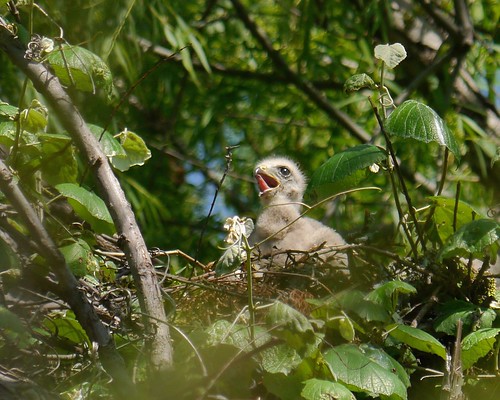
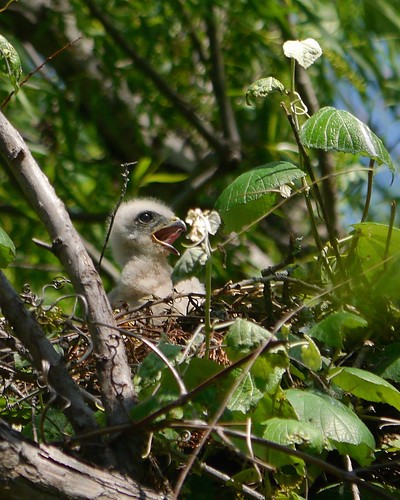
With last night's storm, I wondered if the nest was still there. I know there was hail in central Austin last night but I don't think we got any up here. Still, heavy rain and strong winds can destroy a hawk's nest. When arrived at the Braes Vally parking lot at about 9:00 this morning I didn't see any bird on the nest, but when I returned over two hours later I was pleased to find two white fuzzy nestlings! Only one was visible when I pointed my camera at them, and here are my photos:

Red-shouldered Hawk Nestling - 1


Red-shouldered Hawk Nestling - 2


The nestling was panting, with its tongue stuck out. If this bird thinks it's hot now, he or she is in for a long summer!

Tuesday, April 5, 2016

Birding on Broadmeade Walk

As I finally sit down to write this on Tuesday evening, I just heard a Broad-winged Hawk calling. This species is a newly returning summer resident in our neighborhood. Their distinctive Killdeer-like call is pretty easy to learn. And this species was one we were thrilled to see on the monthly group walk last Sunday morning. Sixteen people joined me at the Parmer Village end of the trail and we ended up recording 47 species of birds. Here are some highlights.

Barn Swallows were present over the pond and along the creek. We watched a few chase a hawk downstream when we first arrived at the last dam. One of them actually struck the hawk a couple times, something I've never seen before. (I've seen Barn Swallows chase hawks before, but never actually hit one.) At first we thought the hawk was a Cooper's Hawk, but later when we saw it again we realized it was a newly returned Broad-winged Hawk. Here are two photos of it from later in the morning, the first with a Barn Swallow in pursuit, and the second of it soaring alone.

Broad-winged Hawk and Barn Swallow


Sunday, August 5, 2012

Birding on Broadmeade Walk

Ten folks showed up this morning for the Birding on Broadmeade monthly walk. We met at the Parmer Village demo homes and spent over two hours covering about a mile of Lake Creek Trail. It was clear and still and warm! But the birding was great fun. Here are some highlights. We started off the walk where we parked, just looking at the Parmer Village pond. The water level is down which has created shorebird and wading bird habitat. South-bound migrating Least Sandpipers, Solitary Sandpipers, Spotted Sandpipers, and year-round resident Killdeer were foraging on the exposed mud. Western Kingbirds and Scissor-tailed Flycatchers were also uncharacteristically on the mud, catching insects. And there were six species of herons and egrets hunting in the shallows: Great Blue Heron, Great Egret, Snowy Egret, Little Blue Heron, Green Heron, and the first Tricolored Heron I've seen on the creek this summer. Tricolored Heron is a coastal species, but this time of year many immature birds wander inland from the coast and show up in central Texas. This was one of those birds. We finally made our way up the trail to the last dam on Lake Creek and got a brief look at this Blue-gray Gnatcatcher in a juniper tree. (Sukumar Veena took the photo.)

Blue-gray Gnatcatcher

Blue-gray Gnatcatchers breed in central Texas, but never in neighborhoods in my experience. (I don't know why.) So I assume this bird was a post-breeding wanderer.

Sunday, October 4, 2015

Birding on Broadmeade Walk

We had a total of 15 people on this morning's monthly group walk. We spent almost 3 hours finding 39 species of birds on Lake Creek Trail, starting at the Parmer Village pond. Most of the birds we observed were only briefly seen or even heard-only., but an exception was Eastern Phoebe. There were many of these flycatchers up and down the trail, likely because the year-round residents were joined by south-bound migrants. Similarly, many Killdeers were present on the soccer fields.

Some of the briefly seen highlights:
  • a Yellow-billed Cuckoo flying across the trail near the last dam
  • a juvenile Sora briefly emerging from the reeds near the last dam
  • a small group of female Blue-winged Teal and a single Snowy Egret foraging in the shallow water of the creek bed
  • a distant Pied-billed Grebe diving and surfacing in the creek upstream of the second dam
  • several heard-only returning winter resident House Wrens, a few of which briefly flew across the trail in front of us
  • a brown female or juvenile male Indigo Bunting
  • two Cooper's Hawks in flight, one that dove at a perched White-winged Dove
The first songbird we got a good close look at was this female Downy Woodpecker:

Downy Woodpecker


And nearby we found this juvenile Green Heron hunting in the creek bed. Soon this summer-resident species will be gone for the winter.

Monday, September 5, 2016

Birding on Broadmeade Walk

Nine folks joined me early Sunday morning for the monthly group walk on Lake Creek Trail. We met at the Braes Valley parking lot and spent about 2.5 hours covering less than a mile of the trail. The birding was an interesting combination of slow but good. Even though the birds were few and far between, and usually hard to see for more than an instant, we ended up accumulating a great list of 41 species including some migrants and post-breeding wanderers.

Post-breeding wanderers are usually first-year birds that are wandering around outside of their usual range after breeding season. The ones we saw were both brief observations of birds flying over us. They were both first-year wading birds. The first was a juvenile Tricolored Heron and the second was a juvenile White Ibis. Both are coastal birds that often wander inland in the late summer.

Migrant songbirds we eventually found included a Yellow-breasted Chat briefly seen by only a few of the group, a green Painted Bunting, 2 empidonax Flycatchers, 2 Blue-gray Gnatcatchers, 2 Yellow Warblers, a Yellow-billed Cuckoo, 2 Orchard Orioles, and 2 Baltimore Orioles. Most of these were brief or distant looks and I only got a few photos. One was of the cuckoo:

Yellow-billed Cuckoo

And here's one of the Baltimore Orioles, a female:

Sunday, September 2, 2012

Birding on Broadmeade Walk

10 folks showed up this morning for the Birding on Broadmeade monthly group walk. We met at the Braes Vally parking lot of Lake Creek Trail at 7:30 this morning and enjoyed unexpectedly comfortable weather. We spent about 2.5 hours on the trail and found 39 species of birds. Many fall migrants are moving south through the area right now. One was this small flycatcher in the Empidonax genus. There are about half a dozen "empid" flycatchers that migrate through central Texas and they're all very difficult to distinguish unless they vocalize. This one was silent except for its non-diagnositic call note.

Empid sp. - 1


Sunday, July 13, 2014

Birding on Broadmeade Walk

Eight folks joined me this morning for the monthly group walk. We met in front of the Parmer Village pond and I photographed this Scissor-tailed Flycatcher while I waited for people to arrive.

Scissor-tailed Flycatcher

It was a fun morning! We ended up spending two and a half hours on the trail and recorded 35 species of birds. By the creek bed near the pond we enjoyed watching Western Kingbirds and Scissor-tailed Flycatchers chasing insects and themselves. As we made our way upstream we heard a Red-shouldered Hawk vocalizing but only got brief looks at it as it flew over the treetops. We also saw four American Crows react to its calls and briefly chase the hawk. As usual, when we reached the last dam on the creek we waited there awhile to see what might show up.

Sunday, September 6, 2009

NASWC Bird Walk

This morning 11 of us met at the Lake Creek Trail parking lot for the September NASWC Bird Walk. It was quite pleasant. There was some color in the sky when I arrived a little after 7:00 AM, and I don't think the temperature got above the mid 80s during the 2 and a half hours we were out. We found 39 species and here are the highlights:
  • A female Summer Tanager was in the willow trees by the parking lot.
  • Many epidonax flycatchers were around, and we got a couple good looks at the most common species, Least Flycatcher. I got this picture of one.


  • We had good luck with Warblers, finding 2 American Redstarts, a Yellow Warbler, at least 2 Wilson's Warblers, and 1 first-year Mourning Warbler.
  • We had pretty good luck with vireos too. After hearing White-eyed Vireos for most of the morning, most of us finally got a pretty good look at one on our way back. And we got decent looks at a couple Bell's Vireos as well.
  • On the footbridge we could see a flock of Roller Pigeons in the distance, most likely circling over the house of their owner. Occasionally we'd see them tumble in mid-air while they flew.
  • On our way back we found this tiny Gulf Coast Toad on the trail.