Sunday, November 30, 2008

Field Sparrows

I spent a cold but fun morning birding the neighborhood. I got out of the house at 7:20 which was just about the earliest time it was bright enough to see birds. Even though the day turned out to be windy, it was almost calm then. Right now it seems like Carolina Chickadees dominate the mixed species foraging flocks in our trees. Three times this morning I heard their distinctive calls and followed them to a nice group of birds. The first time was on Stillforest near Chester Forest where the flock included Ruby-crowned Kinglets, an Orange-crowned Warbler, a Blue-headed Vireo, and 3 species of woodpecker in a single tree -- Red-bellied, Downy, and Yellow-bellied Sapsucker (only here in the winter).

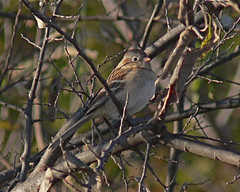
When I got to the T&C playing fields I turned left on the Lake Creek Trail and spent some time on the footbridge there. The footbridge is a great place to find birds since it's the convergence of several habitat types. I saw 5 kinds of sparrows there today: Field, Song, Lincoln's, White-throated, and Dark-eyed Junco. I got this picture of one of the Field Sparrows:

Field Sparrows are partially migratory, and a few breed in the Austin area. They require uninhabited forest edges and openings, or grassy fields with some scattered trees for elevated perches for breeding, so we only see them in the neighborhood during the winter. They are in the Spizella genus which has smaller, more delicate looking sparrows with short bills, unstreaked breasts, and long, narrow, slightly forked tails. (Other Spizella sparrows we get here are Chipping and Clay-colored.) I think Field Sparrows have a very clean look -- not much facial pattern, a bright white eye ring, and a pink bill are good marks to look for.

Happy Thanksgiving! I spent the holiday with my family down on the coast in Port Aransas. Here are some pictures I took while I was down there. Hope you like them!

Tuesday, November 25, 2008

Golden-crowned Kinglet!

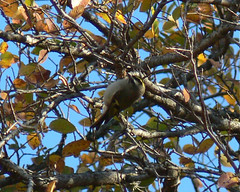
I'm on vacation this week, so I spent a couple hours birding on the streets this morning (Broadmeade, Sherbourne, Longvale, Newberry, Meadowheath, Stillforest, etc.). I was excited to find this Golden-crowned Kinglet on Sherbourne, the first one I've seen in the neighborhood since March, 2007. I think Golden-crowned Kinglets have good years and bad years, or have varying wintering grounds. Some years you can find them in the neighborhood and some years you can't. They look very similar to our much more common Ruby-crowned Kinglets except for the head. Golden-crowned Kinglets have white and black stripes over their eyes with a single yellow ("golden") stripe down the center of the crown which is always visible in both sexes. Ruby-crowned Kinglets don't have any stripes on their face -- they just have a big white eye ring. The males have a red ("ruby") crest which is only visible when they get excited about something and raise it. These 2 kinglets can also be told apart by the sounds the make, which you can listen to at the links above.

Monday, November 24, 2008

Great Price on Great Binoculars for REI Members

I just found out about a great deal on great birding binoculars for REI members. REI has a couple stores in Austin and carries a few binoculars, including the Nikon Monarchs. These are among my highest recommended mid-priced birding binoculars. (See my NASWC article about binoculars for birding.) REI has a coupon for members that gets you 20% off any full-priced item until Sunday. If you use this coupon for a pair of Nikon Monarch 8x36 binoculars, the price ends up being $220 -- about $30 less than what online discount shops charge. (They also have the Monarch 8x42 binoculars, but the discount is not quite as low for these. And the 8x36's are just so handy!)

So if you're an REI member and need a pair of binoculars that are great for birding (or other outdoor uses) check these out!

Update: I just found the slightly larger Nikon Monarch 8x42's on Amazon for $213.27! That's crazily low -- even lower than the 8x36's. Is it a mistake?

Sunday, November 23, 2008

3 Sparrow Pictures

I'm continuing to enjoy the variety of native sparrows that have returned to our neighborhood for the winter. This morning I found 9 species of sparrows (and a total of 45 species of birds) on the Lake Creek Trail starting at the parking lot at the end of Braes Valley and ending up at the patch of marsh near the Parmer Lane bridge. I even got 3 decent pictures. This first one is a Dark-eyed Junco on the ground near the end of Holbrook St. There were 4 juncos, 2 Field Sparrows, and 1 Lincoln's Sparrow foraging in this small area. Juncos are 1 of 3 kinds of sparrows around here with bright white outer tail feathers. If you flush a small bird and you see white outer tail feathers as it's flying away from you, it's probably either a Dark-eyed Junco, a Lark Sparrow, or a Vesper Sparrow. And the dark body and head of the junco make it easy to distinguish once you get a better look.

Near the footbridge at the entrance to the T&C playing fields I ran into a couple White-Crowned Sparrows and White-throated Sparrows which look very similar. I got this picture of one of the White-throated Sparrows. Notice the black and white stripes on the head, which are similar to the White-crowned. But also see how the throat is very white and distinct. And the lore (the area between the eye and the bill) is yellow.


At the end of the Lake Creek Trail near the Parmer Lane bridge (and the lift station) there is a patch of marsh where in 2007 I discovered a few wintering Swamp Sparrows and Marsh Wrens. This season I have not seen a Marsh Wren there yet but this morning reeds seemed full of Swamp Sparrows and Song Sparrows. And I finally got a couple decent pictures of a Swamp Sparrow. Here's one of them. See how gray it is overall, with a white throat (but not as white or distinct as the White-throated Sparrow). And the breast is just faintly streaky.


Sparrows are a hard group of birds to learn. It's hard to get a good look at one and the differences between the species are subtle. But our neighborhood provides a great opportunity to start learning these birds. And once you start, you realize how subtly beautiful our native sparrows are, and it's hard to stop!

Monday, November 17, 2008

Two Little Green Birds

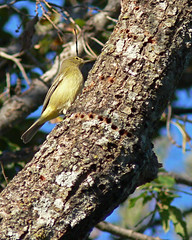
Sunday morning was wonderfully cold and still. When I got out of the house at about 7:30 the temperature was in the upper 30's and there was just a little bit of frost on the ground. One of the first sounds I heard outside was the typewriter-like call of the Ruby-crowned Kinglet, one of two small drab-green birds that spend the winter in our neighborhood. The other is the Orange-crowned Warbler. Right now is a great time to learn how to identify these 2 species since they have returned for the winter in strong numbers. I counted 15 Ruby-crowned Kinglets and 10 Orange-crowned Warblers yesterday morning. The Orange-crowned Warbler is almost uniformly green, sometimes brighter or duller, and sometimes with a grayish head. If you get a close look you can usually see a slight dark line through the eye and a yellowish line above the eye. And the breast is just slightly streaked. (You can almost never see the orange crown.) Here's a picture of a bright one I took on Sunday near Meadowheath and Stillforest. (Notice the rows of holes in the tree trunk. They were made by a Yellow-bellied Sapsucker.)


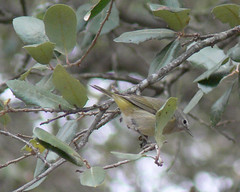
And here's another drabber bird I photographed back in January.


The Ruby-crowned Kinglet is told apart by its big white eye ring and 2 bright wing bars. Here's one of my best pictures of a kinglet in the neighborhood, which I took in March.


These differences are easy to see in these pictures. But usually these birds are actively foraging in the tree canopy, gleaning bugs from leaves and small branches. They almost never hold still. So the challenge is usually getting a good look at one through your binoculars long enough to identify it. Both species can be found by themselves or in mixed species foraging flocks that would likely include our year-round resident Carolina Chickadees.

I found 51 species of birds in the neighborhood on Sunday morning. Some other interesting ones were the first Dark-eyed Juncos and American Goldfinches I've seen this winter. And near the Parmer Lane bridge I saw 2 Monk Parakeets briefly land on a cell phone tower before about 30 European Starlings took flight and the parakeets left. I've only seen Monk Parakeets in the neighborhood once before.

Monday, November 10, 2008

A Buck and Lots of Sparrows

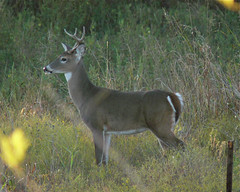
Yesterday (Sunday) morning I birded the east end of the Lake Creek hike-and-bike trail, starting at the new Parmer Village development. It was completely clear, still, and just a little bit cold at first -- a beautiful morning. Walking towards the creek I saw this single-antlered buck making its way upstream. It took very little notice of me -- it gave me a quick look then continued calmly on its way. It was by far the healthiest looking White-tailed Deer I've ever seen in the neighborhood. The coat (now in its grey winter color) was smooth and seemed thick and full. And although small, the deer looked just a bit muscular. (Usually the deer around here look pretty bad off -- thin, and with rough spots on their fur from parasites or mange.) As I was watching it and taking pictures, I heard the crack of a rifle in the distance. My guess is that someone was deer hunting on the private land across Parmer. Deer season in Williamson County has recently begun.

Shortly after that a Great Blue Heron flew by low, headed downstream. (I think I scared this bird out of the Parmer Village drainage pond.) As I watched it I saw a couple flashes, which caught me by surprise. Then I saw that someone on the other side of the creek was taking pictures of the heron. It was nice to know someone else was enjoying the natural beauty of this area too -- and he had come out even earlier than I had!

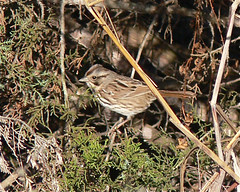
Closer to the creek and towards the lift station there was lots of bird activity. A few Ruby-crowned Kinglets, a single Orange-crowned Warbler, a couple Yellow-rumped Warblers, an White-crowned Sparrow, and a White-throated Sparrow were in the and low trees and brush. The creek bed itself is marshy here, with lots of cattails in the wetter area and other kinds of tall grass in the dryer areas. These cattails and grasses were full of Lincoln's Sparrows, Swamp Sparrows, and Song Sparrows (three similar species, all in the same genus). I was excited to hear a Song Sparrow singing, which is a real treat in Texas. Since these birds don't breed here, they usually don't sing while they're here. The last time I heard a Song Sparrow singing was in early July, while visiting relatives in Montana. It's a beautiful song, and it really enhanced my enjoyment of the cool quiet morning. (You can listen to here.) Below is the best picture I've gotten of a Song Sparrow in the neighborhood so far, from back in February. I hope to get a better picture this winter.


I'll spare you the details, but I found 10 species of native sparrows along the creek on Sunday morning, and 45 species of birds in total.

Sunday, November 2, 2008

NASWC Bird Walk

There were 7 of us for the November NASWC bird walk this morning and we did pretty well, finding 43 species of birds. We met at the Parmer Village development, the eastern end of the new county-built Lake Creek Trail. Before the walk started I took the above picture of a Great Blue Heron flying up the creek in front of the rising sun. We saw a nice variety of wintering native sparrows this morning -- 6 different species. And we had good luck with hawks too. Here are some highlights:
  • First off we checked a patch of marsh on the creek and found Swamp Sparrows. The looks we got were brief but I estimated there were at least 4 birds in the reeds.
  • Downstream we found a single Song Sparrow and 3 Vesper Sparrows.
  • Near the last dam on the creek we saw an Osprey fly over, which we later found perched, and then later saw flying away with a fish in its claws. We also had a close flyover by a Red-shouldered Hawk.
  • In the woods nearby we all got great looks at a Spotted Towhee. For me this was the bird of the morning. It's a large sparrow that is usually very shy and difficult to see. It's a winter resident here, but I only see one every 5 or 6 times I bird the neighborhood so it was great to show one to the group. It's also one of the most dramatically colored sparrows.
  • On our way back we found 3 Chipping Sparrows in a patch of trees, and then this White-crowned Sparrow right on the hike-and-bike trail.


  • At the beginning of the walk an accipiter (either a Cooper's Hawk or a Sharp-shinned Hawk) flew by us low after another bird and briefly landed on the ground before continuing through the trees. And at the end of the walk we watched a Sharp-shinned Hawk soaring overhead.
  • Back at the meeting spot we briefly saw the same B-17 Flying Fortress bomber that flew over the neighborhood yesterday!

Saturday, November 1, 2008

Winter Birds and a B-17

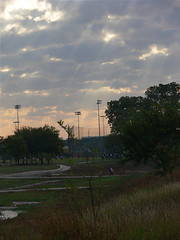
I found 37 species of birds in the neighborhood this morning, starting from my house on Broadmeade and walking down Stillforest and Meadowheath to the Lake Creek Trail. The streets had lots of car traffic for a Saturday morning, which made the birding less enjoyable, but I did find one nice mixed-species foraging flock on Stillforest with a Blue-headed Vireo in it. At the end of Meadowheath I got this picture of the sunbeams coming through the clouds over the T&C playing fields. It was a beautiful fall morning. I took the trail west to the trail head parking lot.

Near the trail footbridge I heard a chip note similar to a cardinal's, but just a bit softer. I recognized it as a Yellow-rumped Warbler and saw the bird a minute later. This is a very common winter-resident bird here and this was the first one I've seen in the neighborhood this fall. Ruby-crowned Kinglets, also common winter residents, are getting more plentiful -- I counted 10 this morning and heard their typewriter-like call all morning. On the trail I also heard a Northern Flicker several times. There were some Orange-crowned Warblers around as well. I heard a few of the soft call notes that native sparrows make, but I never could get a look at one. Near the end of Holbrook I got this picture of a favorite year-round resident, a Northern Cardinal.


I spent a few minutes at the edge of the creek near the trail parking lot looking for shorebirds and only found a single Killdeer and 2 Least Sandpipers. And then I got a surprise when a World War II era bomber flew right over me! I got this picture, and after a quick search on the internet I think it's a Boeing B-17 Flying Fortress. You just never know what you'll see in our neighborhood!


On my way back home I got to add one more returning winter resident bird to my fall list. While talking to a neighbor I saw a Yellow-bellied Sapsucker, one of the 5 species of woodpeckers I've seen in the NASWC area.