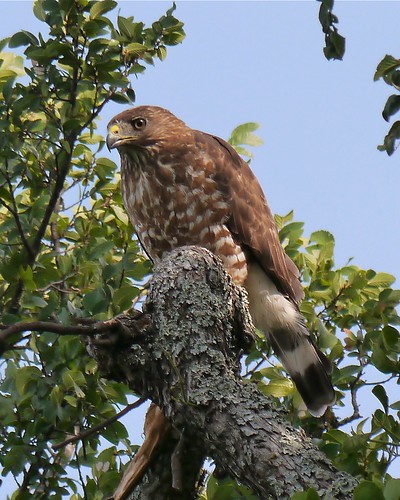
For the past couple months, I've known of a Red-shouldered Hawk nest near the Braes Valley parking lot of Lake Creek Trail. I've checked it whenever I've been out birding and usually have seen a bird on it. Once I was lucky enough to see the two parents trade off incubating the eggs. The smaller male flew in with a big rat, and the larger female left the nest and approached him. He gave her the rat which she took to another perch and started eating. He then got on the nest.
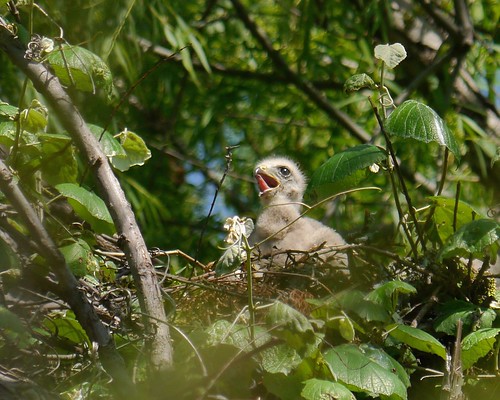
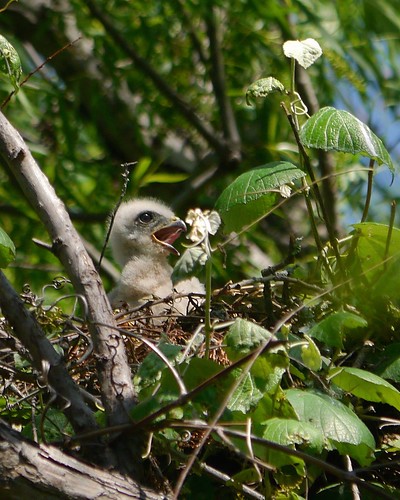
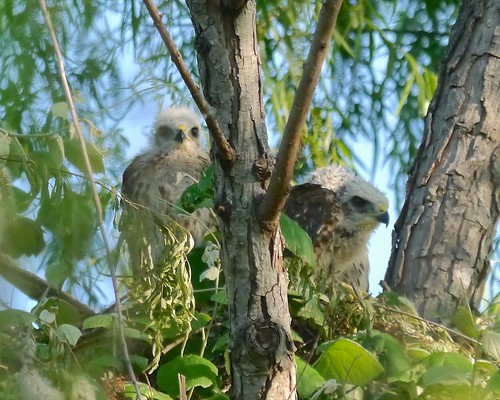
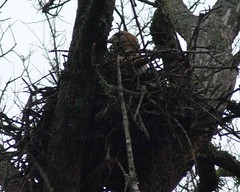
With last night's storm, I wondered if the nest was still there. I know there was hail in central Austin last night but I don't think we got any up here. Still, heavy rain and strong winds can destroy a hawk's nest. When arrived at the Braes Vally parking lot at about 9:00 this morning I didn't see any bird on the nest, but when I returned over two hours later I was pleased to find two white fuzzy nestlings! Only one was visible when I pointed my camera at them, and here are my photos:
The nestling was panting, with its tongue stuck out. If this bird thinks it's hot now, he or she is in for a long summer!
Showing posts sorted by relevance for query red-shouldered hawk nest. Sort by date Show all posts
Sunday, April 19, 2015
Sunday, March 22, 2009
69 Species, 190 total
Wow, what a morning! I left the house at 8:00 AM and finally returned at 1:00 PM after having found 69 species of birds, including a new one for my neighborhood list. It's that time of year when winter residents are still here but north-bound migrants and summer residents are starting to arrive. So there are lots of birds out there to find! Here are the highlights from this morning:
- At Stillforest and Chester Forest the Red-shouldered Hawk nest still has a parent on it. There was also a nice mix-species foraging flock of songbirds. The flock was mostly Yellow-rumped Warblers, with 1 nice male "Audubon's Warbler". This used to be considered a separate species and is very similar to other Yellow-rumped Warblers but it has a yellow throat. I've never seen one in the neighborhood before.
- Near the end of Meadowheath a single Chimney Swift flew over me, the first one I've seen this year.
- Nearby I heard and finally saw a singing male Black-and-white Warbler, one of the earlier warblers to move through the area during spring migration.
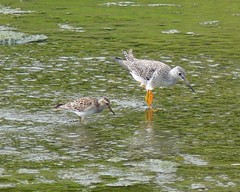
- On Lake Creek near the downstream edge of the T&C playing fields I found a new shorebird for the year, a Pectoral Sandpiper. I got this picture of it foraging next to the larger Greater Yellowlegs. And later I found a few more on the empty soccer fields.

- I saw a single Swainson's Hawk soaring over the T&C soccer fields, the first I've seen this year.
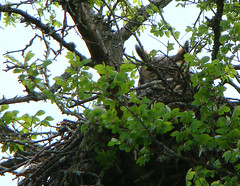
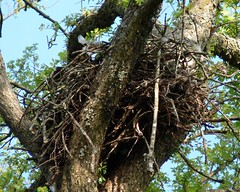
- Near the last dam on the creek I located a Great Horned Owl nest with a parent on the nest. My neighbor Gracen Duffield on Alvin High Ln. found this nest yesterday and sent me a great photo she took of it. (See below.) What's interesting is that last year and the year before, this was a Red-shouldered Hawk's nest (discovered by Steven McDonald). Great Horned Owls are very opportunistic and flexible in their nesting habits.

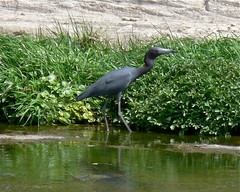
- On my way back home I stopped to look up the creek near the footbridge and found this Little Blue Heron, a handsome bird I usually only see on our creek during migration.

- Nearby next to the small waterfall on the creek, I saw a small bird walking on the rocks and I watched it grab, kill, and eat something tiny from the surface of the water. At first I thought it was a Spotted Sandpiper in breeding plumage but then I saw that instead of spots it had streaks, and it was not a shorebird at all. It was a Louisiana Waterthrush. This is actually a warbler that lives near streams and creeks. It's one of the few warblers that can breed in the Austin area and I've wondered if any spend the summer in our neighborhood. (This bird was probably a north-bound migrant.) It was a first for my neighborhood bird list, bringing my total up to 190 species I've seen here since 2006.
In the past couple days my neighbor Steven McDonald on Perthsire has also been seeing some great birds in the neighborhood. Some that I have not seen yet are migrating Anhingas, a Broad-winged Hawk, a Yellow-throated Vireo, and the first Black-chinned Hummingbird of the season.
According to Blogger, this is my 200th post. I can hardly believe it!
Sunday, May 30, 2010
Red-shouldered Hawk Nestlings
I got out for a jog in the afternoon heat today, and as I went by the corner of Chester Forest and Stillforest I looked up at the Red-shouldered Hawk nest I knew was there. There were 3 nestlings and 1 adult all standing up in the nest. 30 minutes later when I was done jogging I got my camera and walked back there. At that time only 2 nestlings were visible and I got this photo. I'm glad to see this nest was successful again this summer. It has been used by 2 of our resident Red-shouldered Hawks for several years, and it's high enough for the hawks to be unconcerned with people walking around below them.
Sunday, May 3, 2015
Birding on Broadmeade Walk
Fifteen folks showed up for this morning's group bird walk. Usually, the May walk yields some exciting observations of migrating songbirds, since the first few days in May are the peak of spring migration in Austin. But since there haven't been any very recent storms, the north-bound birds have not bunched up in patches of habitat waiting for better weather. There were a few migrating birds here and there but it was a pretty quiet morning.
While we waited for everyone to arrive a few of us got brief and distant looks at a singing first-year male Painted Bunting (an all-green bird). Many Cliff Swallows and Chimney Swifts were also in the sky above us. When we started the walk we checked out the Red-shouldered Hawk nest near the parking lot. There were at least three nestlings in the nest and they were all getting their flight feathers in. I bet they'll be out of the nest in a couple weeks! Here's a photo of two of them:
Nearby we watched male and female Downy Woodpeckers going in and out of a nesting cavity. A little further down the trail some of us got looks at a Least Flycatcher, one of the few actual migrating songbirds we saw. Shortly afterwards we were treated to a migrating Mississippi Kite flying over. It circled over us a few times before heading north and I got this poor photo of that very graceful hawk:
While we waited for everyone to arrive a few of us got brief and distant looks at a singing first-year male Painted Bunting (an all-green bird). Many Cliff Swallows and Chimney Swifts were also in the sky above us. When we started the walk we checked out the Red-shouldered Hawk nest near the parking lot. There were at least three nestlings in the nest and they were all getting their flight feathers in. I bet they'll be out of the nest in a couple weeks! Here's a photo of two of them:
Nearby we watched male and female Downy Woodpeckers going in and out of a nesting cavity. A little further down the trail some of us got looks at a Least Flycatcher, one of the few actual migrating songbirds we saw. Shortly afterwards we were treated to a migrating Mississippi Kite flying over. It circled over us a few times before heading north and I got this poor photo of that very graceful hawk:
Saturday, January 23, 2010
Red-shouldered Hawks
I spent about 2 hours birding the neighborhood today, starting from my house and covering part of Lake Creek Trail. Near the end of Meadowheath I found a pair of Red-shouldered Hawks, a year-round resident species here. I saw another pair at the trail head parking lot off Braes Valley. Red-shouldered Hawks have not been very visible lately, but now they are starting to form pairs and build nests for the summer breeding season. If you've found a Red-shouldered Hawk nest in the neighborhood before, check on it soon. It might be in use again! (I took this photo in the same area back in November, 2008.)By the footbridge I estimated over 200 Cedar Waxwings were flying around and sometimes perching in the tops of the trees. A Cooper's Hawk flew over, which might have been why they were so active.
Sunday, March 6, 2016
Birding on Broadmeade Walk
16 folks met me this morning for the monthly group walk on Lake Creek Trail. It was cool and overcast when we met at 7:30 at the end of Braes Valley. By the time we finished two and a half hours later, the sun was peeking out and it was beautiful. Changing seasons were evident in bird behavior. Many more birds were singing, including two winter resident species that we rarely get to hear before they leave Texas for northern breeding grounds. Before everyone arrived a Spotted Towhee was singing from just east of the parking lot. (We later got to see probably this same bird from the side trail that goes to Briar Hollow Drive.) The other winter resident we got to hear was a Song Sparrow, singing from the creek bed a little further up the trail. Other species we got to hear singing were Ruby-crowned Kinglet, Northern Cardinal, Bewick's Wren, Carolina Wren, and Carolina Chickadee. I briefly saw my first north-bound migrating bird of the season -- a fast flying Barn Swallow that was headed upstream over the creek bed.
Yellow-rumped Warblers and Cedar Waxwings were plentiful. I think waxwing numbers have been augmented by birds that wintered further south starting to head north. I estimated we saw at least 350 waxwings this morning.
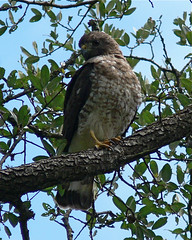
We got to see two species of hawks this morning. Near the trailhead we saw one of the nesting Red-shouldered Hawks and its nest in the willow trees right by the creek. This pair has nested here for the past few summers. We saw another Red-shouldered Hawk by the footbridge. It was a juvenile hunting from one of the wires over the creek bed. We got to see it fly down and come up with what I guessed was a mouse in its claws. here's a distant photo of it perched:
The other species of hawk we got to see was Sharp-shinned Hawk that was hunting on the Town and Country playing fields. It briefly perched near the top of the cottonwood next to the Meadowheath parking lot before continuing its low hunting flight that scared up many grackles and starlings and doves in its path.
Other highlights included close looks at an Eastern Phoebe from the footbridge, a beautiful Great Egret and several Killdeers both in the creek bed, and two female Ladder-backed Woodpeckers chasing each other right in front of us. Here are a few more photos:
Yellow-rumped Warblers and Cedar Waxwings were plentiful. I think waxwing numbers have been augmented by birds that wintered further south starting to head north. I estimated we saw at least 350 waxwings this morning.
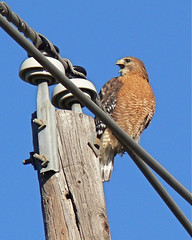
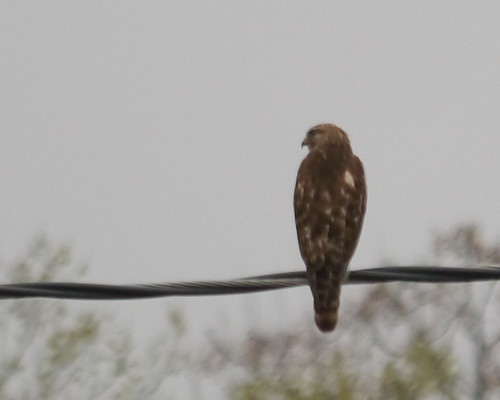
We got to see two species of hawks this morning. Near the trailhead we saw one of the nesting Red-shouldered Hawks and its nest in the willow trees right by the creek. This pair has nested here for the past few summers. We saw another Red-shouldered Hawk by the footbridge. It was a juvenile hunting from one of the wires over the creek bed. We got to see it fly down and come up with what I guessed was a mouse in its claws. here's a distant photo of it perched:
The other species of hawk we got to see was Sharp-shinned Hawk that was hunting on the Town and Country playing fields. It briefly perched near the top of the cottonwood next to the Meadowheath parking lot before continuing its low hunting flight that scared up many grackles and starlings and doves in its path.
Other highlights included close looks at an Eastern Phoebe from the footbridge, a beautiful Great Egret and several Killdeers both in the creek bed, and two female Ladder-backed Woodpeckers chasing each other right in front of us. Here are a few more photos:
Saturday, February 20, 2010
Hawks, Waxwings, Robins
I spent about 3 hours birding the neighborhood this morning, most of the time in heavy mist and drizzle. Starting at my house, I eventually reached the Lake Creek Trail parking lot at the end of Braes Valley before starting back home. I ended up finding 35 species which was pretty good in the wet conditions. At Chester Forest and Stillforest I was happy to see a Red-shouldered Hawk fly into the nest that they've used for the past couple years. I got the poor photo above.At the end of Meadowheath I was excited to find the largest group of Cedar Waxwings and American Robins I've seen this year. I estimated there were about 240 waxwings in the trees and bushes around the gate into the Town and Country playing fields. I walked around the gate and watched them eat berries and fly about for a few minutes. At one point a group of 50 flew out of the trees and right past me, about 5 feet from my head. It was fun hearing their wings cutting the air. On the lawn there were over 100 American Robins, foraging and slowly making their way across the creek to the baseball fields.
On my way home I spent a few minutes on Shady Oaks near an undeveloped lot. Across the street from the lot I saw a long-tailed hawk fly into the dense canopy and perch. When I got my binoculars on it I saw it was a first-year Cooper's Hawk. These are mostly just here in the winter, and specialize in hunting other birds. Their relatively short wings and long tails help them maneuver through the dense tree canopy fast as they chase their prey. This one flew off as I pointed it out to a neighbor.
Saturday, June 7, 2008
A Warm Afternoon
In Texas, you can't pick a worse time to go birding than an afternoon in June. But I hadn't been out all week, and there was a breeze and some cloud cover. So I grabbed my binocs and my camera and spent about an hour and a half birding up Stillforest and then back down Broadmeade. I had a better time than I thought I would, talking to a few neighbors and just barely finding 20 species of birds. Near Chesterforest and Stillforest I did not see any birds on the Red-shouldered Hawk nest, but I did find 2 juveniles perched nearby. I assume they are siblings from the nest. I got this picture of one.
On my way back I found an American Robin nest on Broadmeade near Hazelhurst and got this picture of one of the parents feeding the chicks. I think there are at least 3 chicks on the nest. At Norchester I checked on the Broad-winged Hawk nest and saw 2 adults. I have not seen any nestlings or juveniles yet.
It was surprisingly fun even though I mostly only saw common summer- and year-round-resident species. This makes me hope that my next NASWC article idea will be popular. I'm going to list the 20 most common year-round resident birds in the neighborhood with short descriptions and links to more information about them. And I'm going to challenge people to try and find them all and send me their progress. Then in the NASWC newsletter we'll list people who have seen at least 10, at least 15, and all 20 species. Hopefully it will capture a few people's interest!
Monday, May 18, 2009
Hawk and Mockingbird
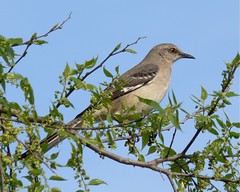
This evening I walked around the streets a bit and did some casual birding. (I didn't bother taking my camera or notepad.) In the undeveloped lot near Shady Oaks and Springvale I heard a Broad-winged Hawk call 5 or 6 times. Last summer a pair of Broad-winged Hawks nested in the neighborhood, at Broadmeade and Norchester. (The picture here is of one of the parents from this nest last year.) So I was pleased to observe the species again this spring. Later my neighbor who lives by last year's nest said that the person who lives next to this lot is seeing nesting hawks in there. Maybe they are the same birds! I was very surprised to find the Broad-winged Hawk nest last year, since we are on the edge of their breeding range. The more common breeding hawk in the neighborhood is the year-round resident Red-shouldered Hawk.Sunday morning on Lake Creek Trail I had an amazing experience with an extremely common bird. As I was standing around watching for migrating birds, a Northern Mockingbird was singing like crazy. I started to recognize different bird species' calls and songs that it was imitating and I started to write them down. I recognized 9 species that this mockingbird was imitating, and it was making plenty more sounds that I did not recognize. Here are the ones I wrote down:
- Blue Jay -- It imitated more than one Blue Jay sound.
- Red-bellied Woodpecker
- Yellow-billed Cuckoo
- Scissor-tailed Flycatcher
- Carolina Wren
- European Starling
- Northern Cardinal
- Chuck-will's-widow, a species only seldom heard along our creek in the spring
- Green Heron -- This one made me laugh. The mockingbird actually made the funny "kyop" sound that these herons make!
What a talented songster! I got this picture of a mockingbird in the same area back in March. Quite possibly it's the same bird.
Sunday, May 25, 2008
Slowing Down and Heating Up
Today was the first day in about 2 months that I did not see a single migrating warbler when I birded the neighborhood this morning. Spring migration is tapering off as the temperature rises and our summer resident birds get on with their lives. The Red-shouldered Hawk nest at Stillforest and Chester Forest had 2 nestlings in it. I got this picture of one of them peeking over the edge. The Broad-winged Hawk nest at Broadmeade and Norchester had one of the parent birds sitting on the nest. Hopefully there will be some young birds visible soon. There are many Carolina Chickadee family groups in our trees these days, the new birds still getting fed by the parents. Here's a picture I got of one chickadee near Stillforest and Meadowheath.
There were just 2 migrating birds I was excited to find this morning. One was an Olive-sided Flycatcher near the Lake Creek Trail footbridge. I saw one near this same spot last weekend and it's a bird I've only seen one other time in the neighborhood. The other was a single female Green-winged Teal on the creek just downstream of the playing fields. This is the first Green-winged Teal I've seen in the neighborhood in over a year. In previous winters I've found a few in this area on the creek but last winter I imagine the construction projects scared them off. Hopefully they will return this winter.
Birds aren't the only colorful animals we have in the neighborhood. Near the last dam on Lake Creek there were several male Longear Sunfish that had cleared off areas of the creek bottom as small territories in which to mate and protect eggs. The males are a striking combination of orange and light blue, with red eyes. I got this picture of one -- it's not great but even through the murky water you can see the color!

Saturday, May 17, 2008
Tanager, Shorebirds, Warblers
Spring migration is continuing, although it seems slower this year than the last 2 years. That might be because we've had more steady south winds and fewer storms and fronts this spring, conditions that cause birds to stop less for breaks on their way north. But the migrating birds are out there -- they're just harder to find. I found this first year male Summer Tanager near the new flood control wall just downstream of the last dam on Lake Creek. Usually in our neighborhood if you see a red bird it's almost definitely a Northern Cardinal. But during the spring and summer a red bird just might be a Summer Tanager. You can see how this one hasn't gotten all its red color yet. It was singing when I took this picture.I had the most success finding migrating shorebirds. I didn't find as many as last weekend, but I did find Least, Pectoral, Baird's, White-rumped, and Spotted Sandpipers. Most were on the creek just downstream of the T&C playing fields, but there was a small group of Baird's and Pectoral Sandpipers on one of the unused soccer fields. Surprisingly, almost nothing was in the new drainage pond near the Parmer Lane bridge where I found the Phalaropes last weekend. I think there's a little too much water in it from recent rains to make good shorebird habitat today.
Warblers have been few and far between this spring, but on my way back I found the first Canada Warbler I've seen this spring. I got a quick but good look at it in the patch of woods near the last dam on Lake Creek. This morning I also was able to find Wilson's, Yellow, Chestnut-sided, American Redstart, and Common Yellowthroat. I briefly heard a Bell's Vireo singing on Stillforest, another first for this spring. And last weekend a neighbor pointed out a Broad-winged Hawk nest to me on Broadmeade. I got this picture of one of the parent hawks near the nest as I neared home. Much more common is the Red-shouldered Hawk in our neighborhood. We're just barely in the breeding range of Broad-winged Hawks.
Sunday, January 25, 2015
Eurasian Wigeon
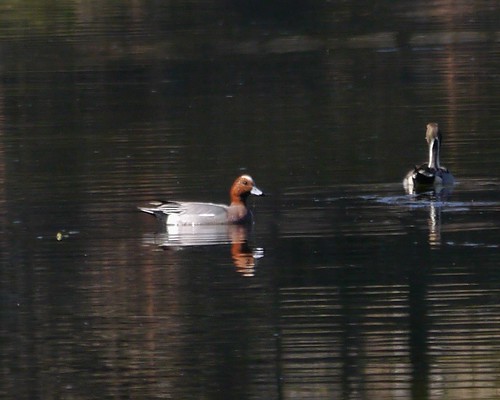
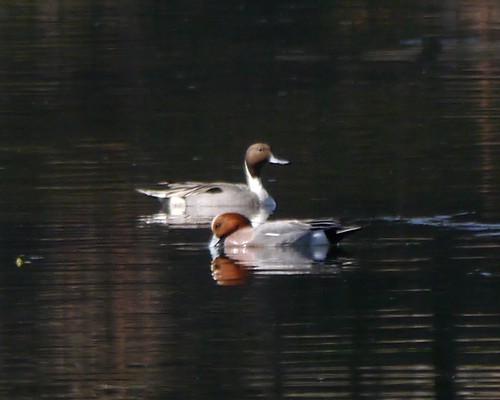
Last weekend I spent Sunday morning birding Lake Creek Trail. I ran into Barry Noret and we had a banner morning totaling 61 species of birds! The most exciting by far was a new bird for Lake Creek Trail, Williamson County, and a lifer (a species we've never seen before) for us both. At about 11:30 we were scanning the creek upstream from the last dam when I saw a duck with a red head. Initially I thought it was a Redhead, a common winter-resident duck on the Texas coast and a little less common inland. But as it turned towards me I could see that its forehead and crown were bright light yellow, like an American Wigeon's white forehead and crown. I also saw that the tail and feathers in front of the tail were black, followed by white a little further up the body, exactly like an American Wigeon. Barry looked it up and realized it was a Eurasian Wigeon! This is the American Wigeon's counterpart in the other hemisphere. They show up occasionally on the east and west coasts of the Americas, but they show up in Texas much less often. I got this distant photo, and we decided to refrain from getting closer and risk scaring the bird away.
So far, this bird has not been seen again since early afternoon on that same day. But it certainly could still show up on the creek again. Here it is in front of a Northern Pintail:
This was species number 223 on my neighborhood list. Back in 2006 when I started keeping bird records in this neighborhood, I never imagined I'd reach 200. But Lake Creek Trail keeps surprising me. In fact, we found species 222 a little earlier that morning.
So far, this bird has not been seen again since early afternoon on that same day. But it certainly could still show up on the creek again. Here it is in front of a Northern Pintail:
This was species number 223 on my neighborhood list. Back in 2006 when I started keeping bird records in this neighborhood, I never imagined I'd reach 200. But Lake Creek Trail keeps surprising me. In fact, we found species 222 a little earlier that morning.
Sunday, March 23, 2008
Easter Morning
This morning my neighbor Steven McDonald and I birded Lake Creek starting at the Town and Country playing fields and going all the way to the Parmer Lane bridge. Even with a chilly wind, we found 52 species of birds. There was more evidence of spring migration today. I counted 5 Great Blue Herons and 7 Great Egrets -- more than I have ever seen on the creek before. Just downstream of the playing fields there was a group of about 20 Blue-winged Teal, 7 Northern Shovelers, 8 Greater Yellowlegs, and 1 Solitary Sandpiper on the creek. The Solitary Sandpiper was the first I've seen this year and I took this picture of it.
Near the last dam Steven found this Pied-billed Grebe which is unusual for the neighborhood and also a first-of-the-year sighting for me. In my picture you can just make out the 2-toned or "pied" bill that these birds get during breeding season.
A couple weeks ago Steven found a Red-shouldered Hawk nest in this area and today we saw the female sitting on the nest with the male perched nearby. In this picture you can just see the hawk peeking at us over the edge of the nest. In the patch of marsh near the Parmer bridge we heard and briefly saw a Marsh Wren in the reeds, 2 Song Sparrows, and heard at least 2 Swamp Sparrows. On our way back through the playing fields we briefly saw a Merlin headed north.
Sunday, March 29, 2009
Lots of Migrants and a Black-throated Sparrow
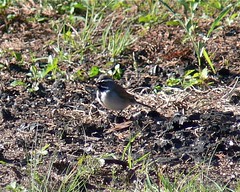
I sure did enjoy birding the neighborhood on this cold and clear morning. On Lake Creek Trail near Holbrook Street I had a huge surprise: this single Black-throated Sparrow. This species has never even been on my mental radar as a possibility here in the neighborhood. It's a southwestern bird that is usually found in desert-like areas. (We are on the eastern edge of their range and we don't have the arid habitat they prefer.) The last time I saw a Black-throated Sparrow was years ago when I took a trip to Big Bend. So I was floored when I got this bird in my binoculars, and I was excited to get a couple identifiable photos. I'm amazed at the birding surprises our neighborhood keeps springing on me. The birding was lots of fun otherwise as well. I started from my house on Broadmeade and found some great mixed-species foraging flocks on Stillforest and on Meadowheath. I counted over 31 Ruby-crowned Kinglets, and most were singing. I got this picture of one on Stillforest:
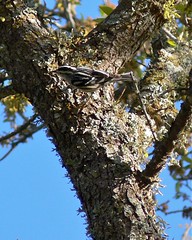
There were also many Blue-gray Gnatcatchers and I counted 9 Nashville Warblers, a new addition to the songbirds moving north through the area. One flock on Meadowheath had all these birds as well as a Blue-headed Vireo, Yellow-rumped Warblers, Orange-crowned Warblers, and 4 Black-and-white Warblers (2 singing males and 2 females). I got this picture of one of the female Black-and-white Warblers:
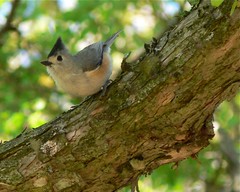
On Chatterton Court I got this picture of a Black-crested Titmouse, one of our year-round resident birds.
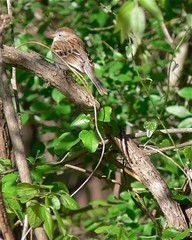
Besides the Black-throated Sparrow, there were lots of other sparrows on Lake Creek Trail this morning. I counted 15 Lincoln's Sparrows and there were a few Field Sparrows singing. I got this picture of one of them.

On my way back I saw the first Broad-winged Hawk I've seen this year, soaring over Lake Creek near the trail footbridge. The Red-shouldered Hawk nest at Chester Forest and Stillforest still has a parent on it incubating eggs. But I checked on the Great Horned Owl nest near the last dam on the creek and did not see a bird on it. Maybe this nest was a casualty of our violent hailstorm last week?
Monday, February 4, 2019
Birding on Broadmeade Walk
Yesterday morning about 20 people joined me for my monthly group walk on Lake Creek Trail. It was foggy but not too damp when we started at the Braes Valley end of the trail at 8:00 AM. Things started a little slow but we ended up having a fun morning, spending 3 hours on the trail and finding 41 species of birds. Sound travels faster and farther through fog, and we felt like some of the birds singing the morning chorus were almost on top of us even though we had trouble seeing them at first.
We checked the side trail that connects to Holbrook St. and we were rewarded with brief looks at a male Spotted Towhee, an uncharacteristically colorful member of the sparrow family, and longer easier looks at a Ruby-crowned Kinglet. Back on the trail we didn't see much until we got to the footbridge where we first heard and then saw a pair of Red-shouldered Hawks in neighbors' yards near the end of Meadowheath. And a few of us got a brief look at a Swamp Sparrow.
Things picked up when we continued down the trail. We decided to go south of the trail among the baseball and soccer fields, hoping to find a Purple Finch. In one of the baseball fields we found over 20 American Pipits foraging in the grass. Further down we found for Northern Flickers, also on the ground. These beautiful woodpeckers are only in the Austin area during the winter and often forage on the ground. I got this poor photo of three of them:

At the eastern low water crossing we were excited to see 38 American Wigeon in the shallow water. You usually have to go further downstream to see ducks on Lake Creek. I was happy that the group was able to slowly cross the creek without scaring them all away. They just slowly moved away from us, sometimes making short flights:
We checked the side trail that connects to Holbrook St. and we were rewarded with brief looks at a male Spotted Towhee, an uncharacteristically colorful member of the sparrow family, and longer easier looks at a Ruby-crowned Kinglet. Back on the trail we didn't see much until we got to the footbridge where we first heard and then saw a pair of Red-shouldered Hawks in neighbors' yards near the end of Meadowheath. And a few of us got a brief look at a Swamp Sparrow.
Things picked up when we continued down the trail. We decided to go south of the trail among the baseball and soccer fields, hoping to find a Purple Finch. In one of the baseball fields we found over 20 American Pipits foraging in the grass. Further down we found for Northern Flickers, also on the ground. These beautiful woodpeckers are only in the Austin area during the winter and often forage on the ground. I got this poor photo of three of them:

At the eastern low water crossing we were excited to see 38 American Wigeon in the shallow water. You usually have to go further downstream to see ducks on Lake Creek. I was happy that the group was able to slowly cross the creek without scaring them all away. They just slowly moved away from us, sometimes making short flights:
Sunday, July 13, 2014
Birding on Broadmeade Walk
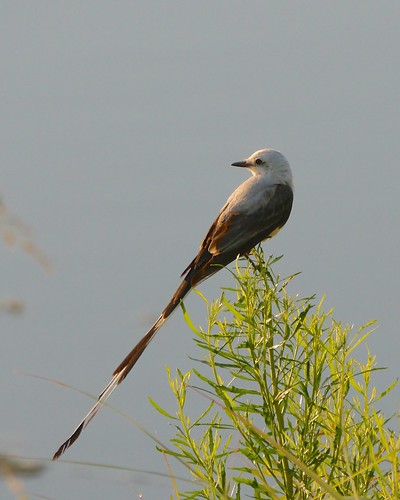
Eight folks joined me this morning for the monthly group walk. We met in front of the Parmer Village pond and I photographed this Scissor-tailed Flycatcher while I waited for people to arrive.
It was a fun morning! We ended up spending two and a half hours on the trail and recorded 35 species of birds. By the creek bed near the pond we enjoyed watching Western Kingbirds and Scissor-tailed Flycatchers chasing insects and themselves. As we made our way upstream we heard a Red-shouldered Hawk vocalizing but only got brief looks at it as it flew over the treetops. We also saw four American Crows react to its calls and briefly chase the hawk. As usual, when we reached the last dam on the creek we waited there awhile to see what might show up.
Sunday, March 28, 2010
First Hummingbird
I spent 3 and half hours birding the neighborhood this morning. I was hoping that the north wind that came in last night would have stopped some north-bound migrating birds here. There were a few around, but no more than I would have expected without the wind. The changing seasons are still evident in our year-round and winter-resident birds as well. The Red-shouldered Hawk nest on Chesterforest had a hawk sitting on it when I walked by. I got this photo, and you can just see the parent hawk's tail on the left side of the nest.
Along Meadowheath the Common Grackles have taken up residence again. I estimated there were at least 20 between Stillforest and the Town and Country playing fields. At the end of Meadowheath I was pleased to hear a few Chipping Sparrows singing. They are about to leave our neighborhood for the summer and it was neat to hear a few before they go. I got this photo of one of the singing birds.
Near the footbridge I heard the raspy call of a Blue-gray Gnatcatcher, one of the earlier birds to migrate north through our neighborhood. It turned out to be a brilliant male, sporting fresh breeding plumage (including that dark line over his eyes and across his forehead). I was able to get this photo of him.
I ran into Barry Noret on the trail and we were excited to see the first hummingbird either of us has seen this year. It was in the woods near the end of Braeburn Glen. It was a male but it was back-lit, so we could not tell if it was a Black-chinned or Ruby-throated. In past summers I've seen a male Black-chinned in this area, so that would be my guess. I suppose I better put my feeder up!
A few other interesting birds we found were a pair of male and female Spotted Towhees, a single White-eyed Vireo singing, Purple Martins and Barn Swallows in the sky, and a Swamp Sparrow by the creek.
Along Meadowheath the Common Grackles have taken up residence again. I estimated there were at least 20 between Stillforest and the Town and Country playing fields. At the end of Meadowheath I was pleased to hear a few Chipping Sparrows singing. They are about to leave our neighborhood for the summer and it was neat to hear a few before they go. I got this photo of one of the singing birds.
Near the footbridge I heard the raspy call of a Blue-gray Gnatcatcher, one of the earlier birds to migrate north through our neighborhood. It turned out to be a brilliant male, sporting fresh breeding plumage (including that dark line over his eyes and across his forehead). I was able to get this photo of him.
I ran into Barry Noret on the trail and we were excited to see the first hummingbird either of us has seen this year. It was in the woods near the end of Braeburn Glen. It was a male but it was back-lit, so we could not tell if it was a Black-chinned or Ruby-throated. In past summers I've seen a male Black-chinned in this area, so that would be my guess. I suppose I better put my feeder up!
A few other interesting birds we found were a pair of male and female Spotted Towhees, a single White-eyed Vireo singing, Purple Martins and Barn Swallows in the sky, and a Swamp Sparrow by the creek.
Saturday, June 30, 2012
Broad-wings on Broadmeade
Last weekend I was walking down Broadmeade for exercise on Sunday morning when Lance Turner saw me and called me over. He wanted to show me the hawks in his yard. Right away I heard one vocalizing and recognized it as a Broad-winged Hawk. We saw at least two birds, one juvenile and one adult. This morning I returned with my camera and got a few decent photos. Here's the adult.
Lance showed me what was probably their nest and I didn't doubt it.
Sunday, June 15, 2008
Broad-winged Hawk Nestling

Friday evening I walked by the Broad-winged Hawk nest at Broadmeade and Norchester. (I was on my way to one of the NASWC wine tasting parties which have been lots of fun and a great way to meet neighbors.) I was excited to see a single nestling looking at me from over the edge of the nest. I've been watching the nest for over a month but this was the first nestling I've seen. This morning I checked the nest again while I was out jogging. I did not see the nestling but one of the parents was flying around nearby making its long single-note call. These birds are very interesting to me because our neighborhood is just barely in the extreme southwestern edge of their breeding range. Red-shouldered Hawks are similar and much more common around here. This picture is of one of the parent Broad-winged Hawks that I took on May 11. I'm hoping I can get some new pictures of the nestling soon.
Sunday, March 26, 2017
Winter to Summer
It had been three weeks since I've birded Lake Creek Trail, so this morning I spent a couple hours starting at the Braes Valley trailhead and making my way to the eastern-most creek crossing. It was exciting to see signs of transitioning seasons from winter to summer. There were increased numbers of some winter-resident birds like Lincoln's Sparrows and Cedar Waxwings. Here are a couple photos I took of a few of about 100 Cedar waxwings perched in the top of a willow tree:


Subscribe to:
Posts (Atom)