
Thursday, July 23, 2009
Broad-winged Hawk
At around 6:00 PM today on my way home from work I was driving east on Shady Oaks when I thought I heard the high-pitched whistle-like call of a Broad-winged Hawk. I started listening for it and heard it again, so I circled back and looked and listened some more. I finally saw the hawk on top of a telephone pole near Shady Oaks and Sherbourne. I pulled over and took a long look and watch it vocalize one more time. It looked like a juvenile bird that was transitioning into adult plumage. Last summer I blogged about a pair of Broad-winged Hawks that built a nest right on Broadmeade. They did not return to that nest this year, but I heard a Broad-winged Hawk earlier this summer near the one I saw today, and I heard from a neighbor that there was a nest nearby. So I'm guessing this bird was part of that brood. Very neat!


Sunday, July 19, 2009
Nest in the Laundry Room, and Yard Lists
 I got a very interesting email from Steven McDonald on Friday. He's an avid birder who lives in the neighborhood on Perthshire, and he sent me some photos of a Carolina Wren nest in his laundry room. I love this picture of one of the parent wrens in the middle of all the familiar household items like WD-40 and Raid! Carolina Wrens are 1 of 2 common year-round resident wren species we have here. (Check out my article about our neighborhood wrens here.) Like most wrens, they are extremely active and inquisitive insectivores, and they are lots of fun to watch. Carolina Wrens are very comfortable on or near the ground, and they hop around and explore every nook and cranny they find. So wrens often find their way into our garages and patios, and often find sheltered places to build nests there. They can raise 2 or even 3 broods in one breeding season, and I'm guessing the nest at Steven's house is at least a second brood. Here's a picture he sent me of one of the hatchlings, just a few hours old, nestled between the fabric softeners and the air freshener!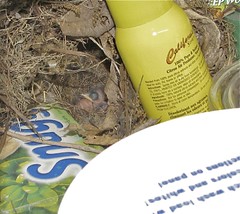
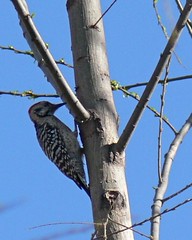
Steven also reached a yard list milestone. On Friday he saw the 130th species of bird in his yard since he started keeping a list a few years ago. Steven's yard list is pretty darn impressive, and it includes a few species I have not yet seen in the neighborhood myself, like White-faced Ibis and Hooded Oriole. Species number 130 was one that had eluded him for awhile: Ladder-backed Woodpecker. This is the least common of the 3 year-round resident woodpeckers that occur in our neighborhood. (The other 2 are Red-bellied Woodpecker and the tiny Downy Woodpecker.) Here's a picture of a Ladder-backed that I took back in March of 2008 on our hike and bike trail. Congratulations on reaching 130 species, Steven!
Sunday, July 12, 2009
Orioles, Martins, Hawk
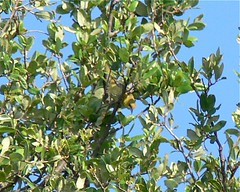
This morning I spent about 2 hours birding our neighborhood hike-and-bike trail, starting at the new Parmer Village development and working my along the creek upstream to the footbridge on the other side of the playing fields. Despite the heat I found 40 species of birds, and I observed the first evidence of southward fall bird migration in the neighborhood I've seen this year. In the woods near the last dam on the creek I found 2 Orchard Orioles, a first year male and a female. These birds are an early south-bound migrant in central Texas and several were also recorded yesterday during the monthly bird survey at Hornsby Bend. I got this bad picture of the female.
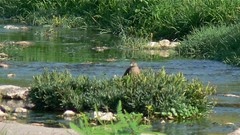
In the T&C playing fields I found about 20 Purple Martins perched on the light posts. In years past, these playing fields have been a roosting site for large groups of Purple Martins around this time of year. After breeding, martins assemble in large communal roosts which may or may not be related to their upcoming southward migration. In the next few weeks watch for larger and larger groups of these birds over the playing fields, in particular over the large baseball diamond. Here's a post I made about the martins gathering here in July of 2007.
Near the footbridge I was excited to find an adult Cooper's Hawk in the creek bed. Cooper's Hawks are common winter residents in our neighborhood, but only a few breed here during the summer. And it's always fortunate to see one because they usually stay hidden in the forest canopy. They specialize in hunting other birds, so they have relatively short wings and a long tail for maneuvering between tree branches when they're chasing their prey. This one soon flew back into the woods as I approached, but I got this poor picture showing its dark cap and red eye.
Sunday, July 5, 2009
NASWC Bird Walk
Despite the warm weather, 5 of us participated in the July NASWC Bird Walk this morning. We were lucky and enjoyed a nice breeze and partly cloudy skies for most of the walk. After a slow start we were able to find 33 species of birds. Here are some highlights.
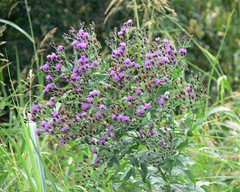
- Bill Dodd identified this vibrant purple flowered plant as Western Ironweed. It's so great that Bill and a few other regular folks on my bird walks know how to identify lots of plants and butterflies!
- A small group of Carolina Chickadees and Black-crested Titmice crossed the trail right over us giving us great looks at these small but common year-round resident species.
- We encountered this group of 8 Snowy Egrets and watched them actively hunting in the creek. Snowy Egrets don't stay as still as other kinds of herons and egrets when hunting. They run and jump around, chasing small fish and aquatic insects.
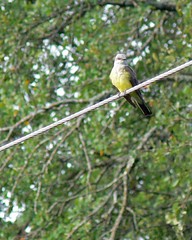
- By the footbridge we saw 2 of the flycatchers I recently wrote about in my Summer Flycatchers blog posts: Western Kingbirds and Great Crested Flycatchers. Here is one of the Western Kingbirds we saw.
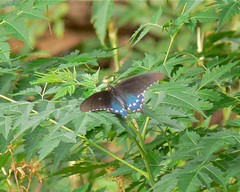
- Right by the trail we found this resting Pipevine Swallowtail butterfly. In my experience, it's fortunate to find one staying still enough to take its picture.

Subscribe to:
Posts (Atom)