Sunday, June 28, 2009

Summer Flycatchers Part 2

On Saturday morning I birded part of Lake Creek Trail with a friend, and despite the heat we found 34 species of birds. 2 of them were Eastern Phoebe and Great Crested Flycatcher, the 2 species I wanted to include in this second post about neighborhood flycatchers. (Here's a link to the first post.) Eastern Phoebe is a rather drab bird with a dark face, head, back, wings, and tail. Its throat, breast, and belly are lighter, sometimes with a slight yellowish tinge. When perched it often pumps its tail up and down, which is a distinctive behavior that can help you identify this species. I got this picture of an Eastern Phoebe just downstream of the T&C playing fields back in 2007.


Even though Eastern Phoebes are migratory, they can be found in the neighborhood all year long. I think they might be similar to American Robins in this way. The individual birds we have here in the summer might not be the same ones that are here in the winter. In the summer I usually see Eastern Phoebes only along the creek. They prefer edges of wooded areas next to water, and and I usually see them near the patches of woods we have by the creek rather than out in the open fields that Scissor-tailed Flycatchers and Western Kingbirds prefer. Eastern Phoebes have a distinctive song, and their name comes from part of the song which (sort of) sounds like the word "phoebe". Learning its song is a good way to find these birds, but beware, their song is often copied by our Northern Mockingbirds!
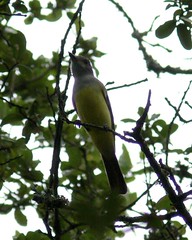
The Great Crested Flycatcher resembles the Western Kingbird in several ways. It has a grayish face and breast, and yellow lower breast and belly. But the gray is darker, and the top of its head and back have much more brown in them than the kingbird. The tail is mostly reddish brown (a color known as "rufous" in the birding world) and this same color can be seen in the wings' primary flight feathers. Despite its name, the Great Crested Flycatcher has only a small crest on its head which is often not raised. (I think the "Great" refers to the bird's overall slightly large size relative to some other flycatchers, and not to its crest.) This is the best picture I have gotten of a Great Crested Flycatcher in the neighborhood so far, and it's only mediocre. I took it in September, 2007.


One reason I don't have a good picture of this bird is because it is the most secretive of the 4 flycatchers I'm writing about. It often remains still, perched in denser parts of the tree canopy,. So seeing one can be difficult and it's a real treat when you do. Usually I hear a Great Crested Flycatcher before I see it, and often even after hearing one I can never lay eyes on it. So it's very useful to learn its harsh song and calls here. Like the Eastern Phoebe, the Great Crested Flycatcher prefers forest edges. But unlike the phoebe, it can be found away from the creek as well as near it. So it occurs among the houses in our neighborhood more often than the other flycatchers do, usually in the heavier wooded areas.

Great Crested Flycatchers breed here, and they are only here in the summer; they winter in southern Mexico and Central America. They are the only neighborhood flycatcher that nests in cavities, both old woodpecker holes and artificial structures. So they are the only neighborhood flycatcher that might use a bird house. Here are some guidelines for making one.

I hope my 2 Neighborhood Flycatcher posts encourage you to keep looking for birds in the neighborhood even through our hot summer months. If you can get outside early enough in the morning it can still be quite pleasant, and that's when the birds are most active and easiest to enjoy.

One last note. Moria Darnell is the first person to complete the NASWC Top 20 Bird List and Challenge! On 6/28 she found 2 juvenile Eastern Screech-Owls on Broadmeade Avenue, the last species she needed. Congratulations Moria!

Sunday, June 21, 2009

Summer Flycatchers Part 1

June is the slowest month for birding in central Texas, but if you get out early enough there are still many year-round-resident and summer-resident birds to enjoy. In the neighborhood right now we have 4 species of breeding flycatchers. Flycatchers are a family of birds that specialize in catching and eating flying insects. As a group they usually have an upright posture and like to perch on exposed branches or fence posts, making forays out to catch a bug and then returning to their perch to eat it. The 2 easiest species to find are Western Kingbirds and Scissor-tailed Flycatchers.

The Western Kingbird is a mid-sized bird with a gray head, grayish throat and breast, a yellow belly, dark wings, and a black squared off tail with white outer tail feathers. I got this picture of one in 2007 near where the footbridge on Lake Creek Trail is now.


The Scissor-tailed Flycatcher is almost the same size but has an extremely long black and white tail that scissors apart when it flies. Its head and breast are white and it has a light pink belly. Under its dark wings are bright pink patches that you usually only catch glimpses of as it flies -- it's a dramatic and beautiful bird to see. Its bright colors and long tail are exotic and tropical, and it's a common neighborhood summer resident! I got this picture of one on the T&C playing fields back in April of 2008:


Both of these species are only here in the summer. They winter in southern Mexico and along the Pacific coast and slope of Central America. Scissor-tailed Flycatchers breed in Texas and a few surrounding states, and Western Kingbirds breed over most of the western and central United States. Both prefer open habitat, with scattered trees or fences to perch and nest on. In the neighborhood I see these birds most often on Lake Creek Trail where it goes through the T&C playing fields, and at the new Parmer Village development. I also often see both species in (of all places) parking lots that have a few trees. It's fortunate for them that they can take advantage of such a common urban setting. Both species make very similar sounds, and often you can hear their single "quip" call notes before finding one on a nearby tree or fence.

These are fun birds to watch. Besides being so pretty, you can often watch them catch insects out of the air and then eat them at their perch. It's also not too hard to find their nests, often right in a large obvious tree in the middle of a field or parking lot. And they are very territorial and aggressive. It is not uncommon to see them chasing off other birds much larger than they are, including hawks, crows, and even Turkey Vultures! So go try to find these 2 species and let me know when you see them!

Sunday, June 14, 2009

NASWC Top 20 Bird Challenge

I did not get outside in the neighborhood this weekend, so I thought I'd post an update about the NASWC Top 20 Bird List and Challenge. This is a list I made of the 20 most common year-round resident birds in our neighborhood. It's a great place to start if you're trying to identify a bird around here. It's also a challenge -- trying to see all 20 birds is a great way to start birding and exploring nature, right in your own yard and neighborhood.

So far 3 people in the neighborhood are taking the challenge. Moria Darnell has seen 19 out of the 20 birds, just lacking Eastern Screech-Owl. Yvonne Daily has found 15, and Teresa Rogers is holding at 12. The details of what they have seen are in PDF format here.

If this sounds fun, give it a try! There's no time limit, and all the birds on the list are here year-round. If you don't live in the NASWC area, that's OK. My list is probably good for most urban and suburban neighborhoods in the Austin area. Go find some birds, start keeping a list, and email me your progress!

Sunday, June 7, 2009

NASWC Bird Walk

This morning 7 of us participated in the June NASWC Bird Walk. We spent a couple hours on Lake Creek Trail, starting at the Parmer Village development and making it to the first baseball field at Town and Country. It was an unexpectedly pleasant morning with some cloud cover and a nice breeze most of the time. We found 35 species of birds, and had a few interesting non-bird species as well. Here are the highlights.
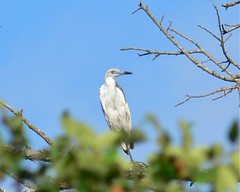
  • This juvenile Little Blue Heron was in the Parmer Village drainage pond where we met, and we later found it again and photographed it in the woods by the creek. Little Blue Heron is a common summer resident in the Austin area, but it's not a bird I see in the neighborhood very often after spring migration.


  • My favorite sight of the morning was a Western Kingbird we watched by the creek as it repeatedly flew down and dunked itself in the water in mid-flight. Then it returned to its perch to preen. I've never seen one bathe like that!
  • A few in the group who know butterflies were excited to find a rare Arizona Sister by the creek.
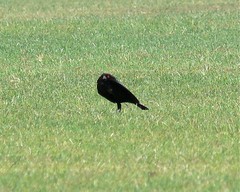
  • In the south baseball field at Town and Country, we found a pair of Bronzed Cowbirds. I got this picture of the male with its feathers puffed out to attract the female. Look at those red eyes!


  • Twice in patches of woods by the creek, we heard Green Treefrogs, a species I've never observed in the neighborhood before.
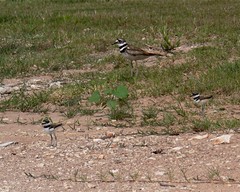
  • Back at the Parmer Village model homes parking lot we found 4 baby Killdeer with about 6 adults. I got this picture of 2 of them.


Saturday, June 6, 2009

Summer Birds and a Butterfly

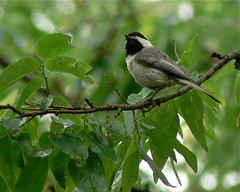
I spent about 3 hours birding the neighborhood this morning, and for the first time since March I did not see a single north-bound migrating bird. All the birds I found were year-round or summer residents. I started from my house this morning, which is something I haven't done in awhile. I took Sherbourne to Broadmeade to Meadowheath to Lake Creek Trail. Traffic was light and there were few people mowing their lawns, so birding on the streets was pretty fun. On Sherbourne I found this juvenile Black-crested Titmouse in its nest cavity and I got this picture. See how it has a crest, but the crest is not yet black like an adult's. The hole this bird was in was probably originally made by a woodpecker, and I think it's large enough for European Starlings to use, so I was happy to see that the titmice held onto it long enough to raise a brood.

Later as I was walking down Meadowheath an American Robin flew up to a low branch over the side of the road about 12 feet in front of me. I realized it was sitting on a nest and I got this picture.


We have American Robins in the neighborhood all year long, but I'm not sure if we have the same robins all year. The robins nesting here now might still be migratory and spend the winter further south. We have more robins here in the winter, and I assume that most of these birds summer further north. The species has a very interesting range map here.

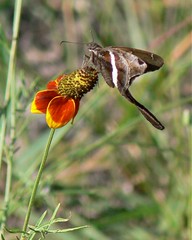
On the flood plain property near the end of Holbrook, an unusual butterfly caught my eye and I took this picture. It looked like it had streamers trailing from its wings. It turned out to be a White-striped Longtail, which I've seen in the neighborhood before. These butterflies occur as far south as Argentina, and central Texas is the northern limit of their range. Wow! I love the different shades of brown in its wings, offset by the bright white stripe. It's feeding on a Mexican Hat wildflower.