Sunday, May 31, 2009

Feeling like Summer

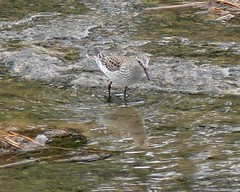
I spent about 3 hours birding Lake Creek Trail yesterday morning, starting at the Parmer Village community. It's starting to feel like summer. The weather was bright and hot, and numbers of north-bound migrating birds are tapering off. The only migrants I found were 1 Least Flycatcher, 1 Mourning Warbler, 1 Pectoral Sandpiper, 4 Spotted Sandpipers, and 1 White-rumped Sandpiper. Summer birding takes on a different focus than in the spring when all kinds of birds are passing through the area. Species diversity is lower and birding becomes more about appreciating the summer and year-round resident species we have here, like these 2 Inca Doves in their fresh breeding colors that were foraging near the last dam.


Among the other summer birds I found were juvenile Barn Swallows being fed by their parents (sometimes in mid-air), a Scissor-tailed Flycatcher chasing off an American Crow, a few Eastern Phoebes (the only flycatcher that you can find in the neighborhood year-round), a male Black-chinned Hummingbird, and 2 White-eyed Vireos.

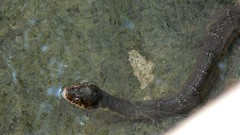
I encountered 2 or 3 Blotched Water Snakes on the creek and got this picture of one. Our creek has lots of water snakes in it and I think Blotched Water Snakes are the most common kind. They eat anything they can catch in the creek, including fish, frogs, and crawfish. They grow to be 3-4 feet long, and they are non-venomous. Back in 2007 I posted about finding one in the process of swallowing a large bass and I put up a series of pictures. Here's my blog post and here are the pictures. Be warned, the pictures are a bit gruesome!


Sunday, May 24, 2009

Flycatchers, Warblers and Sandpipers

Late Saturday afternoon there was heavy rain in the neighborhood for about an hour. During spring migration, a weather event like this causes birds heading north to stop and wait for the weather to improve. So in the spring it's always a good idea to check your favorite birding spot after a rainstorm, and I got out this morning and birded Lake Creek Trail for about 3 hours. It was a little strange because I forgot to bring my notepad and pen, so I couldn't record accurate numbers of all the species I saw. I'm so used to doing this that birding that trail without a notepad felt weird! But it was a nice break not counting every group of White-winged Doves or Common Grackles or Great-tailed Grackles that flew by.

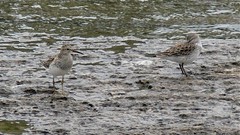
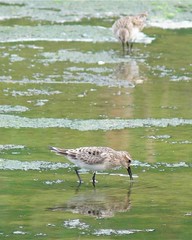
I was most excited to find 4 White-rumped Sandpipers and 4 Pectoral Sandpipers on the creek. In the right habitat, both are common spring migrants in central Texas. And Pectoral Sandpipers are not too uncommon on our creek during the spring. But I have only seen White-rumped Sandpipers a handful of times in the neighborhood. My pictures don't do them justice. Their subtle silvery grey and white and black plumage is accented by just a few flecks of reddish brown. When they fly you can see their white rump. These are some of the farthest migrating birds in the western hemisphere, wintering in southern-most South America and breeding in the Canadian Arctic. I'm glad a few could stop and refuel on our creek. In the photo below, a Pectoral is on the left (with the yellow legs) and a White-rumped is resting on the right.


The woods along the creek was full of flycatchers, mostly Eastern Wood-Pewees and birds in the Empidonax genus (empids). This genus is infamous for being difficult to identify down to species. The easiest way is by the birds' songs, and a few were vocal this morning. So I was able to identify at least 2 Least Flycatchers, 1 Alder Flycatcher, and 1 Willow Flycatcher. I estimated I saw 8 or 10 empids all together.

In the same woods I found 6 species of warblers. There were at least 4 female American Redstarts foraging and flaring their tails in the willow trees, along with a Yellow Warbler. In the dense woods off the trail I found a female Canada Warbler. And back along the sidewalk In a narrow strip of woods by the creek I found a Wilson's Warbler, a beautiful Magnolia Warbler, and a singing male Mourning Warbler. What a fun morning!

Wednesday, May 20, 2009

Eastern Box Turtle

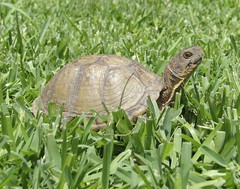
This morning I got an email from Steven McDonald, fellow birder and neighbor on Perthshire. Today he found and photographed this female Eastern Box Turtle in his yard. He said:
Found this little girl wandering around our front flowerbed. It's an Eastern Box Turtle, only had 3 toes on both hind feet. She actually has a little burrow dug in the corner so I'm hoping she's going to lay eggs there.
Wow, I hope so too! Our creek is full of water turtles like Red-eared Sliders, but these days land turtles are few and far between. Box turtle populations have plummeted over the last 30 or 40 years, so finding a wild one in our neighborhood is very special. It's very interesting to me that in late April 2007 I found a male Ornate Box Turtle in our neighborhood and in late May 2008 Steven found one in his yard. So we're averaging 1 box turtle sighting per spring! If you find a box turtle, please let me know. And Texas Parks and Wildlife is interested too. Please fill out their sighting form here.

Monday, May 18, 2009

Hawk and Mockingbird

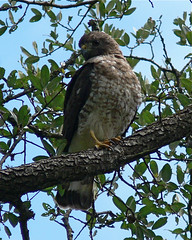
This evening I walked around the streets a bit and did some casual birding. (I didn't bother taking my camera or notepad.) In the undeveloped lot near Shady Oaks and Springvale I heard a Broad-winged Hawk call 5 or 6 times. Last summer a pair of Broad-winged Hawks nested in the neighborhood, at Broadmeade and Norchester. (The picture here is of one of the parents from this nest last year.) So I was pleased to observe the species again this spring. Later my neighbor who lives by last year's nest said that the person who lives next to this lot is seeing nesting hawks in there. Maybe they are the same birds! I was very surprised to find the Broad-winged Hawk nest last year, since we are on the edge of their breeding range. The more common breeding hawk in the neighborhood is the year-round resident Red-shouldered Hawk.

Sunday morning on Lake Creek Trail I had an amazing experience with an extremely common bird. As I was standing around watching for migrating birds, a Northern Mockingbird was singing like crazy. I started to recognize different bird species' calls and songs that it was imitating and I started to write them down. I recognized 9 species that this mockingbird was imitating, and it was making plenty more sounds that I did not recognize. Here are the ones I wrote down:
  1. Blue Jay -- It imitated more than one Blue Jay sound.
  2. Red-bellied Woodpecker
  3. Yellow-billed Cuckoo
  4. Scissor-tailed Flycatcher
  5. Carolina Wren
  6. European Starling
  7. Northern Cardinal
  8. Chuck-will's-widow, a species only seldom heard along our creek in the spring
  9. Green Heron -- This one made me laugh. The mockingbird actually made the funny "kyop" sound that these herons make!
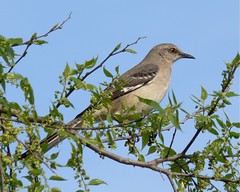
What a talented songster! I got this picture of a mockingbird in the same area back in March. Quite possibly it's the same bird.

Sunday, May 17, 2009

Beautiful Weekend

It's mid May, and I'm feeling reflective about birding. I feel like I should be tired of it, and in some ways I am. Over the years I've learned that from April through the end of May, birding should rise in priority a couple notches. Getting out to bird as often as possible is rewarded by finding more birds of more species than I can find at any other time of the year. Sometimes it feels like a chore but once I'm outside I never regret it. Birding connects me to the natural world. I can see and hear and feel seasonal changes happen, big and small. Trees leaf out. Grass grows and wildflowers bloom. Our year-round resident birds like Carolina Chickadee and Carolina Wren start appearing in family groups feeding new fledglings. Numbers of winter resident species peak then dwindle as they leave for breeding grounds: first Yellow-rumped Warblers then Orange-crowned Warblers and Ruby-crowned Kinglets, then Savannah Sparrows and Lincoln's Sparrows. Northbound migrating species appear, and their numbers peak then dwindle too -- Blue-gray Gnatcatchers, then Clay-colored Sparrows, then Common Yellowthroats (still peaking now)...

The spring weather is dynamic. Warming south winds are relieved by cold fronts and thunderstorms. These fronts ground the northbound migrating birds, so spring birding can be the most exciting just minutes after a storm passes through. Being outside then is magical. The air is clean and cool and clear. The sky is dark in some places, light in others. Thunder still crackles in the distance. And the birds are active, making up for lost foraging time.

I thought a lot about these things as I was on Lake Creek Trail this weekend. We got our last break from the coming heat today, and birding in 65 degree weather one more time was a treasured experience. I'll skip my usual rundown of species highlights for now. Maybe tomorrow night. (I added 3 species to my neighborhood list, now at 195, one I've only seen once before, and one I've never seen before.) For now, just know that it was beautiful out there.

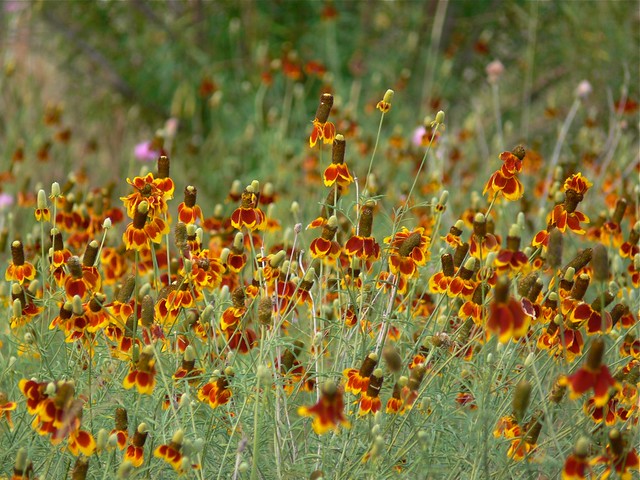
Mexican Hat

Thursday, May 14, 2009

Common Yellowthroat, Fledgling Wren

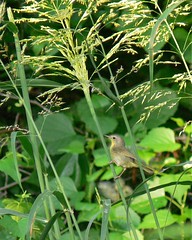
I spent a couple hours birding Lake Creek Trail today after work. Things were kind of slow as I expected. I saw this female Common Yellowthroat by the willow trees at the edge of the creek. It popped right up when I pished and briefly perched in the tall johnson grass. This species is probably the most common spring migrant warbler in our neighborhood. Nearby was a Yellow Warbler in the upper canopy of the same willow trees, and an Eastern Wood-Pewee a little lower.

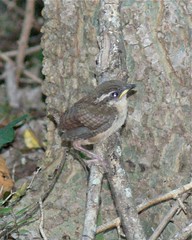
By the footbridge I heard some chirping in the woods and found a family group of Carolina Wrens. There were 2 parents and 3 fledglings, all hopping around near the ground. I got this picture of one of the fledglings. See how it has the basic pattern of the adults (the stripe over the eye, buffy breast and brown back and wings), but see how short the tail and wings are. And also see the yellow coloration around the mouth. Many young birds have this and I believe it makes their open mouth more obvious when they beg for food from their parents. (This bird's eye is lit up from my camera's flash.)

Tuesday, May 12, 2009

Orange Warbler, Red Snake

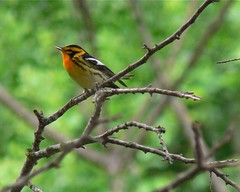
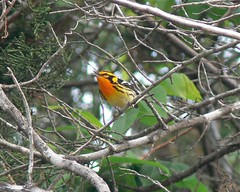
I'm a little late posting again. Sunday morning I spent about 4 hours birding the neighborhood, starting from my house and covering most of the Lake Creek Trail and some streets in between. The persistent south winds for the past week or so have made it hard to find north-bound migrating birds. It's great for the birds -- they have a tailwind on their journey -- but they stop less frequently so it makes it harder for us birders to see them. So I was thrilled when I found this singing male Blackburnian Warbler on the trail just upstream of the footbridge. I didn't even have to leave the sidewalk. There are certain brilliantly colored birds that can make a normal person into a birder with just one look, and this one of them. (The first time I saw one I thought of the orange crayon in the old fluorescent set that Crayola used to make.) I missed seeing one last year, so I was so very happy to find this one on Sunday. It made my week. This species winters in northern South America and breeds in Canada and the Appalachians. They prefer the upper tree canopy and forest interiors, so the widespread fragmentation of forests is not good for them. And much is left to be discovered about the details of their lives.

As I was watching the Blackburnian, a different warbler that prefers the understory made a brief appearance: a male Mourning Warbler. This species is one of the later migrating songbirds through our area, and thus is a reminder that spring migration will be over by the end of the month.

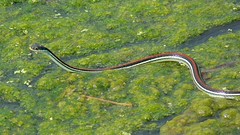
Further downstream on the trail, as I walked up to the last dam on the creek, I saw this tiny black and red snake lunge out from the bank. It stayed on the algae of the shallow water and I got this picture. When I got back home I identified it as a Redstripe Ribbon Snake, and I was very interested to learn that it only occurs in central Texas, along creeks and streams. It mostly eats cricket frogs which our creek is full of.

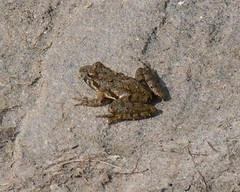
In fact, the snake had lunged after this little guy, a Blanchard's Cricket Frog, which escaped the snake after my appearance on the scene. These frogs make a loud clicking sound, like pebbles struck together, that you can often hear by our creek any time of the day.
On my walk home I went down Sherbourne, a new favorite street of mine for finding birds. I was not disappointed. In a Live Oak in someone's front yard I saw a blob along a horizontal branch that looked like a bird. Sure enough, when I got my binoculars on it I saw a sleeping Common Nighthawk. This is a summer resident species all over north America, and has recently returned to our neighborhood. Despite the name, they are not hawks -- they're related to Whip-poor-wills. They fly around all night catching bugs out of the air. You can often hear them in parking lots and catch glimpses of their long striped wings as they fly past streetlights.


Tuesday, May 5, 2009

A Warbler and 2 Sandpipers

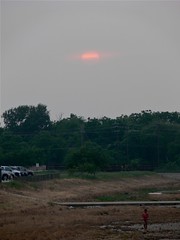
I spent a couple hours this evening on Lake Creek Trail and found 2 first-of-the-year species for my neighborhood bird list. Near the parking lot at the end of Braes Valley I got a very brief and unsatisfying look at a male Mourning Warbler in the willow trees by the creek. This is one of the later migrants to move through the Austin area. And just downstream of the playing fields I found these 2 Baird's Sandpipers on one of the few patches of shorebird habitat we have on the creek. On my way back I got a brief look at the setting sun through the haze and got this shot over the creek.

Sunday, May 3, 2009

NASWC Bird Walk

This morning 9 of us met at 7:30 for the May NASWC bird walk. Last year the May walk was the most exciting of the year, and I think today's walk was probably the most exciting of 2009. We had a pretty good showing of spring migrant birds. Although it was not as spectacular as I had hoped (probably because most of the storms passed through north of Austin) we still found 52 species including 9 species of warblers. Here are the highlights:
  • We saw and heard a beautiful male Northern Parula in the large Cottonwood tree near the trailhead. It was soon joined by a Warbling Vireo.
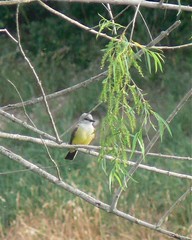
  • By the creek we found this Western Kingbird, a common summer resident in the Austin area that is now returning.


  • By the creek we also found 1 or 2 female Painted Buntings, and I got this picture of one of them. We saw several more and finally saw a colorful male when we got to the footbridge.


  • Also from the footbridge we got a good look at a nearby Yellow-crowned Night-Heron.
  • On our way to the bridge we found a single female American Redstart and on the way back we found this male. Both were fanning their colorful tails as they foraged. Redstarts are infamous for being even more active than most other warblers, which makes it hard to get a good look at them.


  • We ended the walk by a strip of Willow trees and a single Mulberry tree by the creek near the trailhead that had several birds, including Yellow Warblers, Wilson's Warblers, Common Yellowthroats, and a single Yellow-breasted Chat.

Saturday, May 2, 2009

10 Species of Warblers

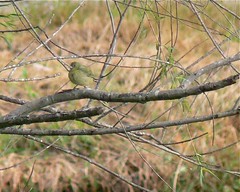
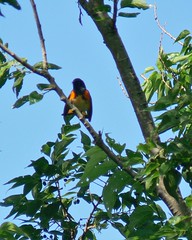
I had an unexpectedly good morning birding the neighborhood today. It's the best time of year -- spring migration peaks the first few days of May in the Austin area -- but the steady south winds usually make the migrating birds harder to find. (They have a tailwind so they keep flying north.) Still, this time of year it's worth getting out to bird as often as you can. Things started slow and frustrating. There seemed to be more traffic on the roads than usual, and there were several people mowing their lawns on the path I took. But when I crossed the Lake Creek Trail footbridge onto the flood plain property things got much better. I quickly found a Wilson's Warbler and then a male Canada Warbler. Then I heard the begging calls of juvenile Carolina Chickadees, so I followed them. There are often other birds in loose association with family groups of chickadees or wrens, so these groups are always worth investigating. As the parent chickadees fed their begging fledglings, I saw these additional warbler species nearby:
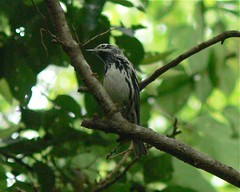
2 more warbler species that turned up in the low brush were Common Yellowthroat and a Yellow-breasted Chat. A nice male Baltimore Oriole and a single Mississippi Kite were the other interesting migrants I saw this morning. The only picture I got was of the Black-and-white Warbler. If you click on the picture and look closely, I think you can see a band on its left leg.


The wind is supposed to shift to the north tonight, and thunderstorms are expected tonight and tomorrow. This means migrating birds will be grounded and easier to find. So watch the weather and get out between the storms to find some birds!