Sunday, March 29, 2009

Lots of Migrants and a Black-throated Sparrow

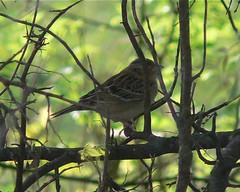
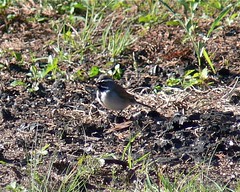
I sure did enjoy birding the neighborhood on this cold and clear morning. On Lake Creek Trail near Holbrook Street I had a huge surprise: this single Black-throated Sparrow. This species has never even been on my mental radar as a possibility here in the neighborhood. It's a southwestern bird that is usually found in desert-like areas. (We are on the eastern edge of their range and we don't have the arid habitat they prefer.) The last time I saw a Black-throated Sparrow was years ago when I took a trip to Big Bend. So I was floored when I got this bird in my binoculars, and I was excited to get a couple identifiable photos. I'm amazed at the birding surprises our neighborhood keeps springing on me.

The birding was lots of fun otherwise as well. I started from my house on Broadmeade and found some great mixed-species foraging flocks on Stillforest and on Meadowheath. I counted over 31 Ruby-crowned Kinglets, and most were singing. I got this picture of one on Stillforest:
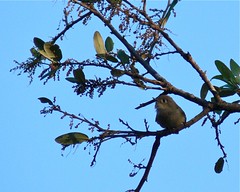

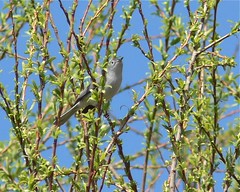
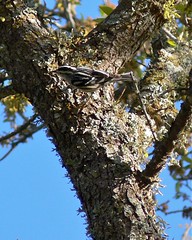
There were also many Blue-gray Gnatcatchers and I counted 9 Nashville Warblers, a new addition to the songbirds moving north through the area. One flock on Meadowheath had all these birds as well as a Blue-headed Vireo, Yellow-rumped Warblers, Orange-crowned Warblers, and 4 Black-and-white Warblers (2 singing males and 2 females). I got this picture of one of the female Black-and-white Warblers:

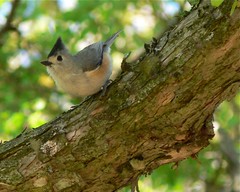
On Chatterton Court I got this picture of a Black-crested Titmouse, one of our year-round resident birds.

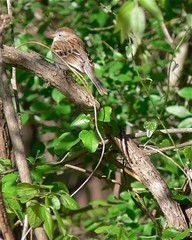
Besides the Black-throated Sparrow, there were lots of other sparrows on Lake Creek Trail this morning. I counted 15 Lincoln's Sparrows and there were a few Field Sparrows singing. I got this picture of one of them.

On my way back I saw the first Broad-winged Hawk I've seen this year, soaring over Lake Creek near the trail footbridge. The Red-shouldered Hawk nest at Chester Forest and Stillforest still has a parent on it incubating eggs. But I checked on the Great Horned Owl nest near the last dam on the creek and did not see a bird on it. Maybe this nest was a casualty of our violent hailstorm last week?

Saturday, March 28, 2009

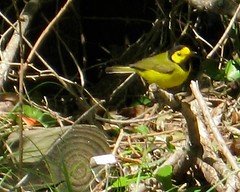
Hooded Warbler

Around lunchtime today I got an email from Barry Noret who lives just across 183 from our neighborhood on Swallow Drive. He saw a male Hooded Warbler in his backyard this morning and got this picture of it. I've only seen a Hooded Warbler once before in the neighborhood, so I was excited to hear about this nearby sighting. Hooded Warbler is one of the earlier warblers to migrate through the area this time of year. I'll be out birding the neighborhood tomorrow morning and hope to see one myself!

Tuesday, March 24, 2009

Lots of Northbound Migrants

I spent a couple hours birding the neighborhood after work today. I was impressed by the increasing numbers of north-bound migrants around. There were lots of tiny Blue-gray Gnatcatchers. (I got this picture of one last Friday.) Their soft raspy call is a common sound on our streets and on the trail right now. There are also lots of Yellow-rumped Warblers, and the males are just starting to emerge into their bright breeding plumage. Many Ruby-crowned Kinglets are still here, and they are now singing. They have quite a complex song and it's surprising to hear it from such a small inconspicuous bird, especially since all winter long all I've heard is there typewriter-like clicking call.

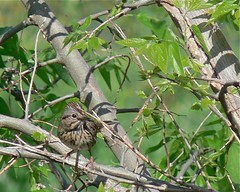
On Lake Creek Trail between the parking lot and the footbridge Lincoln's Sparrows are more numerous than in the past few weeks. Lately I've been seeing them in groups of 3 or 4. I got this picture of one last Friday.


By the new parking lot I was excited to see a single Grasshopper Sparrow. This is a bird I usually only get to see a few times per year. It's a grassland species that we only see in the neighborhood during migration, or very rarely during the winter. This was the first one I've seen here since April, and I got this poor picture.


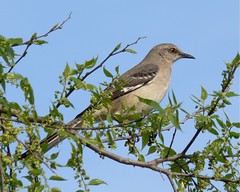
I'll end this post with a much better picture. Our state bird, Northern Mockingbirds are common year-round residents here and often let you get very close to them. This one was near the Grasshopper Sparrow and was much more cooperative for photographing.

Sunday, March 22, 2009

69 Species, 190 total

Wow, what a morning! I left the house at 8:00 AM and finally returned at 1:00 PM after having found 69 species of birds, including a new one for my neighborhood list. It's that time of year when winter residents are still here but north-bound migrants and summer residents are starting to arrive. So there are lots of birds out there to find! Here are the highlights from this morning:
  • At Stillforest and Chester Forest the Red-shouldered Hawk nest still has a parent on it. There was also a nice mix-species foraging flock of songbirds. The flock was mostly Yellow-rumped Warblers, with 1 nice male "Audubon's Warbler". This used to be considered a separate species and is very similar to other Yellow-rumped Warblers but it has a yellow throat. I've never seen one in the neighborhood before.
  • Near the end of Meadowheath a single Chimney Swift flew over me, the first one I've seen this year.
  • Nearby I heard and finally saw a singing male Black-and-white Warbler, one of the earlier warblers to move through the area during spring migration.
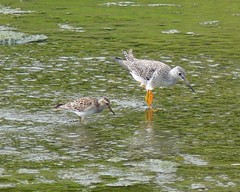
  • On Lake Creek near the downstream edge of the T&C playing fields I found a new shorebird for the year, a Pectoral Sandpiper. I got this picture of it foraging next to the larger Greater Yellowlegs. And later I found a few more on the empty soccer fields.

  • I saw a single Swainson's Hawk soaring over the T&C soccer fields, the first I've seen this year.
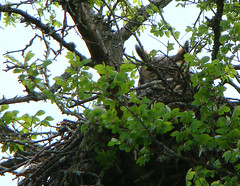
  • Near the last dam on the creek I located a Great Horned Owl nest with a parent on the nest. My neighbor Gracen Duffield on Alvin High Ln. found this nest yesterday and sent me a great photo she took of it. (See below.) What's interesting is that last year and the year before, this was a Red-shouldered Hawk's nest (discovered by Steven McDonald). Great Horned Owls are very opportunistic and flexible in their nesting habits.


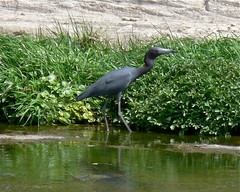
  • On my way back home I stopped to look up the creek near the footbridge and found this Little Blue Heron, a handsome bird I usually only see on our creek during migration.


  • Nearby next to the small waterfall on the creek, I saw a small bird walking on the rocks and I watched it grab, kill, and eat something tiny from the surface of the water. At first I thought it was a Spotted Sandpiper in breeding plumage but then I saw that instead of spots it had streaks, and it was not a shorebird at all. It was a Louisiana Waterthrush. This is actually a warbler that lives near streams and creeks. It's one of the few warblers that can breed in the Austin area and I've wondered if any spend the summer in our neighborhood. (This bird was probably a north-bound migrant.) It was a first for my neighborhood bird list, bringing my total up to 190 species I've seen here since 2006.
In the past couple days my neighbor Steven McDonald on Perthsire has also been seeing some great birds in the neighborhood. Some that I have not seen yet are migrating Anhingas, a Broad-winged Hawk, a Yellow-throated Vireo, and the first Black-chinned Hummingbird of the season.

According to Blogger, this is my 200th post. I can hardly believe it!

Saturday, March 21, 2009

Solitary Sandpipers

It's Saturday afternoon and I'm finally making a quick post about birding on Thursday. I had the afternoon off and spent about 3 hours birding Lake Creek Trail starting at the new parking lot and walking the entire length to the Parmer Village development. On the creek next to the parking lot I found a new bird for the year -- 2 Solitary Sandpipers. I got this picture of one, eating something it just caught. These birds breed in the boreal forests of Alaska and Canada, and they winter in central and south America. A few actually winter in south Texas, and sometimes a few can be found in the Austin area in the winter. 2 winters ago I actually found a few on Lake Creek. But since then I have only seen them here during migration and in the summer.

It's interesting. Many shorebirds like the Solitary Sandpiper spend very little time actually on their breeding grounds. According to the TAS Austin-area checklist, Solitary Sandpipers are most common around here from mid-March to mid-May during spring migration, and then from July until September during their fall migration. So from March until September, that leaves only about a month and a half when we don't see any in the Austin area either heading north or heading south.


Monday, March 16, 2009

2 Fuzzy Photos

I birded different parts of Lake Creek Trail yesterday (Sunday) morning and today after work. It's fun to see more and more summer resident birds are showing up. Cave Swallows nest under the Parmer Lane bridge and a few are starting to appear on the trail again. Over the creek just downstream of the T&C playing fields I watched 5 or 6 flying low over the water catching bugs. I got this poor picture of one. It's fuzzy but you can see its field marks -- the buffy rump, dark orange forehead, and light orange throat. The very similar Cliff Swallow has a much darker throat, and a light spot on the forehead. Interestingly, Cliff Swallows are much more common under bridges and overpasses in the Austin area. But in our neighborhood, Cave Swallows are more common.

At the other end of Lake Creek Trail I was excited to see a Little Blue Heron on the creek, the first I've seen this year. Unfortunately as I moved to a better angle to try and get a picture of it, a dog off leash scared it away.

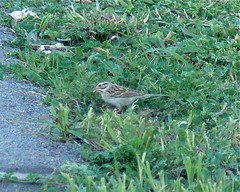
At the trail head parking lot, I found 3 Clay-colored Sparrows right at the edge of the asphalt, feeding in the grass. These little sparrows spend the winter in Mexico and winters in the northern United States and Canada. So we only get to see them when the pass through during migration. I got this fuzzy picture of one.

Saturday, March 14, 2009

Northbound Songbirds

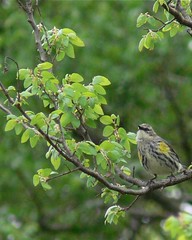
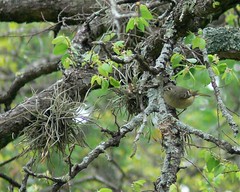
This morning I slept in to nurse a mild cough I picked up last week. But this afternoon I couldn't resist getting out to bird the neighborhood for a couple hours. I walked about a mile and a half on the streets around my house and was excited to see the first major movement of north-bound migrating songbirds I have seen in the area. I ran into 5 large mixed-species foraging flocks while I was out. The first was the largest, and included 3 species I had not seen yet this year in the neighborhood: Blue-gray Gnatcatcher, Nashville Warbler, and Black-and-white Warbler. But mostly these flocks were full of 3 common winter resident species that are now preparing to head north. While I was out I estimated that I saw 21 Orange-crowned Warblers, 30 Ruby-crowned Kinglets, and 32 Yellow-rumped Warblers. I managed to get these 2 pictures of a Yellow-rumped Warbler and a Ruby-crowned Kinglet.


Near Chester Forest and Stillforest, I saw a Red-shouldered Hawk on the nest I observed last year. I assume it was incubating eggs, although it's a little bit early.


Sunday, March 8, 2009

4 Hours of Birding

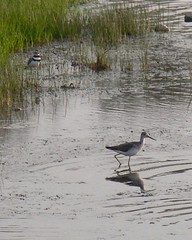
This morning I was finally able to spend all morning birding the neighborhood, something I haven't been able to do in about a month due to traveling and other commitments. I found 60 species of birds, including a few interesting north-bound migrants. Starting at the Parmer Village development, I found this Lesser Yellowlegs on their new drainage pond. A few of these birds winter in the Austin area but I've never found a wintering bird in our neighborhood. I've only seen the very similar Greater Yellowlegs here in the winter, so I assume this Lesser Yellowlegs is a north-bound migrant. Telling Lesser and Greater Yellowlegs apart can be tricky, but in this case it was pretty easy. The Lesser Yellowlegs is about the same size as a Killdeer while the Greater is substantially larger. As you can see in the picture, a Killdeer was conveniently close so I could compare it to the Yellowlegs.

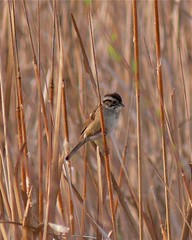
In the marshy area near the Parmer Lane bridge I had pretty good luck. I found a single Sedge Wren (probably the same bird I've photographed there before) and got some good looks at Swamp Sparrows. I got this decent picture of one of them. A single Barn Swallow flew over, another north-bound migrant, and I estimated that 80 Cave Swallows have returned to their mud nests under the bridge. I still have not seen a Marsh Wren here this winter, although at least 2 were here last winter.

Near the last dam on Lake Creek I briefly heard and then later briefly saw a Great Horned Owl. These are year-round residents in the neighborhood but it's always a treat to see or hear one. I saw several Field Sparrows in this same area, and for the first time this year I heard and watched a couple of them singing -- a definite sign of spring. In one small group of Field Sparrows I also found a Clay-colored Sparrow. We only see a few of these birds in the Austin area, only during migration. This bird is just a little bit early according to the TAS Austin area checklist.

On the stretch of Lake Creek Trail next to the T&C soccer fields, I found a small flock of finches, mostly American Goldfinches, but including 1 Lesser Goldfinch, 2 House Finches, and 1 Pine Siskin. Pine Siskins are an irruptive winter resident here. Some winters they are present here in significant numbers and some winters they are not. This winter they have been widely reported in the Austin area. (Steven McDonald has seen and photographed a couple of these birds in his backyard on Perthshire.) But this was the first time I personally saw one here in the neighborhood. It brings my neighborhood bird list up to 189 species.

Monday, March 2, 2009

Harris's Sparrow and Wood Duck

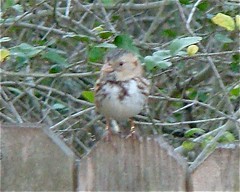
Sunday I was excited to get an email from neighbor and fellow birder Gracen Duffield who lives on Alvin High Lane, with a heavily wooded stretch of Lake Creek right behind her house. She got this picture of a Harris's Sparrow perched on her fence. A few of these sparrows have been regular visitors to her backyard. I've never seen a Harris's Sparrow in the neighborhood and it can be hard to see in the Austin area in general. Nice find!

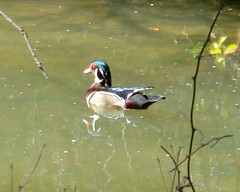
Besides the sparrows, Gracen has been seeing Wood Ducks on her sheltered stretch of the creek. She got this picture of a male. I've only seen Wood Ducks once before in the neighborhood back in May. It just goes to show you that this neighborhood is too rich with bird species for one person to see them all!


I spent this last weekend down on the coast in Port Aransas for their annual Whooping Crane Festival. I led the birding bus tours on Saturday and enjoyed a tour of the Fennessey Ranch on Friday. Here are a few pictures I took while down there.