Monday, December 22, 2008

Pine Siskin

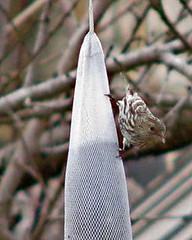
Saturday, my neighbor and fellow birder Steven McDonald emailed me this picture of a Pine Siskin at his backyard feeder on Perthshire. I've been hearing about lots of Pine Siskin sightings in the Austin area for the past few weeks, so I was excited to hear about one in our neighborhood. Pine Siskins breed in northern or high altitude conifer or mixed coniferous forests. (I saw many of them in the mountains of Montana last summer when I visited my relatives up there.) In the winter some stay where they are and some are migratory. And they are considered irruptive -- they sometimes travel to different places in the winter from year to year depending on availability of food or on other factors. So some winters we see them in the Austin area and some winters we don't. This winter we do!

I have not yet seen a Pine Siskin in the neighborhood, so I hope to find one soon. They look very similar to female House Finches, which are common year-round residents here. Both are very streaky birds, but the streaks on a Pine Siskin are more pronounced and defined than on the House Finch. Pine Siskins also have longer and pointer bills, although both birds have the conical bills of seed eaters. And the male Pine Siskin has yellow in its wings and tail. So keep an eye open for these irregular winter visitors, especially if you have a thistle feeder.

Sunday, December 14, 2008

An Hour on the Streets

This morning I got a late start and spent just a little over an hour birding a few streets of our neighborhood. It was a comfortable but breezy morning and wind makes it hard to find birds. Birds are so light that they usually stay hunkered down and hidden when it's windy. So the birding was slow until I stopped at a brush pile on Barryknoll St. and pished. The brush pile exploded with bird life, including this Orange-crowned Warbler, about half a dozen House Sparrows, a Ruby-crowned Kinglet, 2 Carolina Wrens, 1 Bewick's Wren, 1 Northern Mockingbird (pictured below), and 2 Northern Cardinals. I could hardly believe all these birds had been silently hiding right in front of me. I love brush piles!

Thursday, December 11, 2008

Red-naped Sapsucker

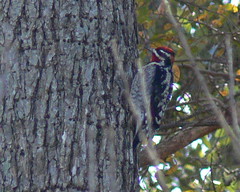
Saturday morning (December 6) I spent about 3 hours birding the neighborhood. On my way back at about 10:30 I was walking on Sherbourne when this bright male sapsucker caught my eye. Sapsuckers are a kind of woodpecker that drills rows of holes in tree trunks and drinks the sap that leaks out. They also eat some of the bugs that are attracted to the sap. (In the picture you can see rows of holes on the tree trunk made by this bird and probably others.) Yellow-bellied Sapsuckers occur in the eastern half of the United States and we have them in our neighborhood during the winter. They are pretty inconspicuous and I usually only see 1 for ever 2 or 3 times I go out birding.

But I noticed a couple things about this bird that made me think it was not a Yellow-bellied. There was some red on the back of the head, and there seemed to be more red in the throat than I'm used to seeing. So I took a few pictures and compared them to my field guides when I got home. Sure enough, this bird was a Red-naped Sapsucker which is a species from the western half of the country. During the winter they usually do not occur east of the Trans-pecos region of Texas, so it's a rare bird for the Austin area.

Male Red-naped Sapsuckers look very similar to Yellow-bellied Sapsuckers, but they have more red on their heads. They have a little red on the back of the head and more on the throat. Also, the black border between the red on the throat and the lower white stripe on the face is much narrower (or even absent) on the Red-naped. This Red-naped Sapsucker was a new bird for my neighborhood list: number 187!

Monday, December 8, 2008

NASWC Bird Walk

Yesterday morning 8 of us met at the Parmer Village development for the December NASWC bird walk. The conditions were cold, clear, and absolutely calm as the sun rose. By the time we were done, it was warmer, a little wind had picked up, and we had found 35 species of birds. Here are the highlights.

  • We saw small groups of American Goldfinches in the patch of woods by the creek. These winter residents have been increasing in numbers for the past few weeks.
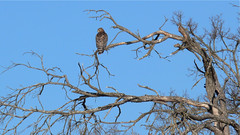
  • This Red-shouldered Hawk was perched over the creek near the last dam and did not seem to mind us at all.

  • 2 Spotted Towhees were heard and briefly seen in the patch of woods near the creek.
  • I was most excited to find about 12 Cedar Waxwings eating hackberries near the edge of the same patch of woods. These sleek beautiful birds are winter residents and were the first Cedar Waxwings I have seen this season.

Wednesday, December 3, 2008

45 Minutes on the Trail

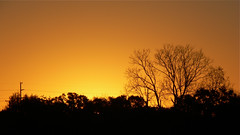
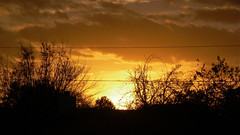
After an annoying few days at work this week I got home a little early today and spent about 45 minutes on Lake Creek Trail. When I got home at about 4:30 it was calm and comfortable outside but 20 minutes later when I got out on the trail it was noticeably cooler and the windy. I got this shot of the sun setting near Holbrook St.

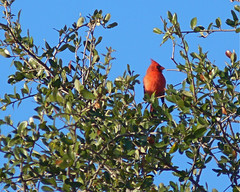
Evening is usually not a very good time to find birds, and wind makes it even harder, so I only found 13 species between the trail parking lot and the footbridge. These included a Great Egret and 2 Wilson's Snipe on the creek. I also found 4 species of native sparrow between the trail and the creek bed (Chipping, Field, Song, and Lincoln's). These and the sunset colors in the sky on the way back easily made this the best 45 minutes of the week so far.